
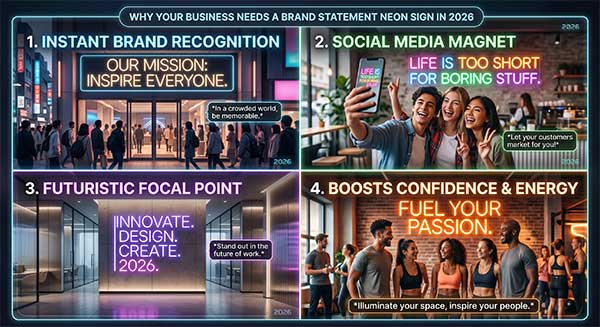
A brand statement neon sign puts your company’s words on the wall in light: a tagline, a mission line, or a core value that a visitor reads in two seconds and remembers afterwards. It is the piece of signage that says something rather than simply showing your logo — and because it carries language, it has to be planned differently from a logo sign or an OPEN sign. This guide covers what to write, where to hang it, how big to make it, what it is made of, what drives the cost, and how to brief a fabricator so the finished sign looks like it belongs to your brand.
Related products: Love Wins Neon Sign – Home, Living Room & Bedroom Equality, Frame the Magic – Photo Studio Neon Sign.
What Counts as a Brand Statement Neon Sign?
A brand statement neon sign is a custom LED neon piece built around a phrase that represents your business — “Built to Last,” “Better Together,” “Hustle and Heart,” “Innovation Starts Here.” It is designed as visual communication first and decoration second. The wording, typography, colour and layout are chosen to carry personality and values, not just to fill a wall.
That distinction matters before you brief anyone, because it changes every downstream decision: how many words you can use, which font will bend cleanly, how wide the sign has to be, and how it will look in the photos people take in front of it.
Brand Statement Sign vs. Logo Sign vs. Functional Sign
| Sign type | What it shows | Best placement | Main job |
|---|---|---|---|
| Brand statement sign | A tagline, value or mantra in words | Reception, culture wall, photo wall | Reinforce identity, create shareable moments |
| Logo sign | Your wordmark or icon | Above reception, behind the desk, storefront | Recognition and wayfinding |
| Functional sign | OPEN, WALK-INS WELCOME, ORDER HERE | Window, door, counter | Trigger an immediate action |
Plenty of businesses end up with two or three of these. If you are starting with one, a logo sign wins on instant recognition while a brand statement sign wins on memorability and on how often it ends up in customer photos. The logo side of that decision is covered in our guide to custom logo neon signs for brand building.
Three Things a Brand Statement Sign Has to Do
- Read in one glance. A visitor should absorb the whole line instantly — usually two to five words across one or two lines.
- Look like your brand. Font and colour should extend the identity you already use, not introduce a second one.
- Survive the camera. Most of these signs exist partly to be photographed by customers, staff and you, so they have to look right at the angles people actually shoot from.
What Should Your Brand Statement Sign Actually Say?
This is the decision that stalls most buyers, and it is worth settling before you look at a single font. You are choosing one line that a stranger will read in about two seconds.
How Many Words Fit
Two to five words is the practical range for a wall-mounted statement. A single word reads as a label rather than a statement; beyond roughly six words the sign has to grow wide to stay legible, which pushes it toward storefront scale and a larger budget. If you cannot say it in a line, it is not yet a brand statement — it is a paragraph, and paragraphs do not work in neon.
Where to Find the Wording
- Your existing tagline. If marketing already uses it, the sign reinforces language people have seen rather than introducing something new.
- A core value. Values work especially well because they double as internal messaging — the same reason office neon signs built around company culture are so common in lobbies and meeting rooms.
- A team mantra. Short, informal lines often photograph better than formal corporate language and are easier for staff to repeat.
Avoid any slogan that needs a sentence of explanation to make sense. If it needs explaining, it will not survive the two-second glance.
Where Should You Hang a Brand Statement Neon Sign?
Placement decides whether the sign is decoration or part of how the business operates day to day. These are the placements that consistently earn their wall space.
Reception and Lobby Walls
The first wall a visitor faces. It sets the tone before anyone speaks and is the most-seen surface in most offices, which makes it the default home for a statement sign.
Meeting Room and Behind-the-Desk Walls
Culture messaging lands hardest where teams actually work. A value on the wall behind a desk is read by employees every day, not only by guests, so it keeps doing a job long after the launch photo.
Retail Window and In-Store Walls
A window-facing statement sign works the street side of the business. It draws the eye from the pavement and keeps working after closing time at no staffing cost, which is why it pairs well with a standard open-hours sign nearby.
The Content or Photo Wall
If you publish photos or video, a dedicated wall with your statement sign becomes a repeatable backdrop. Colour choice matters more here than anywhere else: the same words read warm and playful or cool and corporate depending on the light temperature you pick, and displays never match LED output exactly.
Trade Show Booths and Pop-Ups
Lightweight LED neon panels pack flat and reinstall quickly, which makes them practical for temporary stands and seasonal pop-ups where the wall changes every few weeks.
How Big Should a Brand Statement Sign Be?
Sizing is more predictable than it looks. Two rules of thumb cover most rooms, and they agree with each other.
- The 60–70% rule. The sign should fill roughly 60–70% of the space you are placing it in — not the whole wall, and not a small patch of it.
- The two-thirds wall rule. A sign should take no more than two-thirds and no less than one-third of the wall width it hangs on. A 48-inch wall therefore wants a sign between 16 and 32 inches wide, with about 24 inches as the middle ground.
Measure the total visual footprint, not just the glowing tubing. If your sign sits on a shaped acrylic backing, the backing is part of the size, and a design that looked perfectly proportioned on a phone screen can look tiny on a real wall. Our custom neon sign size guide includes a size-by-wall chart if you want a starting dimension for a specific room.
| Placement | Typical wall width | Starting sign width |
|---|---|---|
| Meeting room / behind the desk | 3–4 ft | 16–20 in |
| Reception / lobby | 5–6 ft | 24–32 in |
| Retail window / dining wall | 8 ft and over | 36–48 in |
| Storefront / hero wall | Full frontage | 48–72 in and over |
Materials, Power and Mounting: What You Are Actually Buying
Nearly all modern “neon” signage is LED neon flex: silicone tubing with LEDs inside, bent to shape and mounted on a cut acrylic backing. Traditional glass neon still exists, but for a brand statement sign the LED version is the practical choice on almost every count.
LED Neon vs. Traditional Glass Neon
LED neon runs on a low-voltage 12V or 24V DC adapter and draws roughly 0.8 to 1.2 watts per linear inch. Traditional glass neon needs a high-voltage transformer and draws several times that. The difference shows up on the electricity bill when a sign runs all day, and it also shows up in handling: LED neon runs cooler, has no fragile glass to break in transit, and is rated for a long service life.
Rated life for quality LED neon is commonly quoted at 50,000 to 100,000 hours — the point at which brightness has dropped to around 70% of new rather than the point at which the sign fails. In practice that is decades of evening use. Heat is the main enemy of that figure, so avoid placing the sign against a radiator or in direct, unshaded sunlight, and use the supplied adapter rather than a third-party charger with the wrong voltage.
Mounting Options
- Clear acrylic backing — the sign arrives as one rigid piece, the simplest to hang and the easiest way to keep exactly the shape you approved.
- Cut-to-letter backing — each letter is a separate piece, giving a floating look on the wall but needing more careful layout on site.
- Standoff mounts — the sign sits off the wall and casts a shadow that reads as depth, a popular choice for lobbies.
- Hanging kits — for signs suspended over a desk, counter or bar.
Power and Cabling
Plug-in adapters are standard for indoor signs. Battery packs suit smaller, portable pieces and can help at trade stands with no convenient socket, but they suit short lines better than wide installations. Cable routing is worth deciding early: a sign looks far cleaner when the plan for hiding the cable is made before the wall is measured rather than after.
Indoor vs. Outdoor
An indoor sign needs no weather protection. Anything facing a street, a covered exterior entrance or a damp environment needs an outdoor-rated build, and if your statement sign will be visible from outside you should ask for the IP rating before you order rather than after.
What Drives the Cost of a Brand Statement Neon Sign?
Pricing follows a small set of drivers, and once you know them you can estimate a sign before you ask for a quote.
| Cost driver | What it does to the price |
|---|---|
| Overall size | The single biggest factor — more tubing, more backing and more bending labour |
| Number of letters and words | More separate pieces means more assembly and layout work |
| Colour count | Multi-colour designs need more material changes and more wiring |
| Backing style | Cut-to-letter and standoff builds cost more than a single acrylic plate |
| Controls | Dimmers and app or RGB control add hardware |
| Turnaround | Rush production carries a premium over standard lead time |
For concrete bands, our custom neon sign cost guide lists typical market ranges by size — small text signs at the low end and multi-colour storefront-scale pieces well above that — along with the add-ons that move an invoice most. The short version: size and colour count decide most of the price, and a two-word single-colour statement sign sits at the affordable end of the market.
How to Brief a Neon Sign Manufacturer
Most disappointing signs are the result of a vague brief rather than poor fabrication. A short, specific enquiry gets you an accurate quote and a design you can actually picture.
What to Send in Your First Enquiry
- The exact wording, character for character.
- Your wall width and height, measured — not estimated from a photo.
- Where it will hang (indoor wall, window, lobby, booth) and whether it is visible from outside.
- Your brand font name, or a logo file, if the sign must match your identity.
- Preferred colours and whether they have to match an existing brand palette.
- Any deadline, stated honestly, because rush work changes both price and feasibility.
Artwork and Fonts
Your brand font matters more than most buyers expect. A thin script that reads beautifully in a logo can become hard to bend in neon at small sizes, while a heavy geometric font scales up cleanly. A good fabricator will tell you when a font will not translate and suggest the closest workable alternative instead of quietly producing a sign that looks nothing like your identity. If you are comparing suppliers, our guide to choosing a neon sign manufacturer covers the questions that separate an actual fabricator from a reseller.
Five Mistakes That Make a Brand Statement Sign Look Cheap
- Too many words. A paragraph in neon reads as noise. Keep it to a single line.
- The wrong size for the wall. A 16-inch sign on an 8-foot wall disappears; a full-wall sign in a small office overwhelms it.
- A font that clashes with your brand. If your identity uses a clean sans-serif, a curly script sign looks like a different company moved in.
- Colour chosen from a screen. Monitors and LED output do not match, so ask for a physical or photographic colour reference rather than trusting a swatch on your display.
- Ignoring the camera. If the sign exists to be photographed, check it looks right from the angles people really shoot from — behind a desk, in front of a window, and at night.
Does a Brand Statement Sign Help Online?
Indirectly, and often more than businesses expect. A wall-mounted statement sign becomes the background in customer photos, staff content and event coverage, and every one of those images carries your words with it. Location tags, reviews and social posts that feature the space all reinforce the same phrase, which keeps the brand recognisable across channels and gives people something concrete to associate with the name.
Unlike a paid campaign, the sign keeps working after the budget stops. It is a one-time build that stays in the room and in the background of every photo taken there, which is what makes it an asset rather than an expense.
Frequently Asked Questions
How long does a brand statement neon sign take to make?
Small text signs are the quickest, while larger multi-colour pieces take longer because of the extra assembly and layout work. Exact lead times depend on the design and current workload, so confirm them at quote stage rather than assuming a standard turnaround.
Can I use my exact brand font?
Usually yes, if the font is licensed for this use and bends cleanly at your chosen size. Very thin or highly decorative fonts may need a small adjustment to stay legible in neon, and a good fabricator will flag that before production.
Do I need an outdoor-rated sign for a window?
Only if the sign is exposed to weather or direct sun. A sign behind glass in a sheltered window is normally fine as an indoor build; a sign facing the street needs the outdoor-rated version.
What if I don’t know what my sign should say yet?
Start from what you already repeat in marketing — your tagline, a core value, or a phrase your team uses. Settle the wording before design, because it drives the length, the size and ultimately the budget.
Getting Your Brand Statement Sign Made
Y SIGNS is the manufacturer, not a middleman. Designs are made to order in the brand colours and fonts you specify, with mounting hardware and installation guidance included, and every project is confirmed with you before anything is built. Bring us the line you want to say, the wall it is going on and the look you are after, and we will turn it into a design you can approve with confidence.
Start with our custom neon sign builder to sketch your wording and dimensions, or get in touch and we will advise on the right size and build for your space.