
u/BrightSignsBuyer · 456 points · 3 months ago
I’m launching a custom neon sign retail store and want to know — how do I actually choose a neon sign manufacturer? There are so many options online, and I’ve heard mixed things about MOQ, quality, and whether I should go OEM or work with a supplier. What are the red flags?
87 Comments · Share · Save
u/MakerMike · 89 points · 3 months ago
Great question. Here’s what I learned after going through this myself —
The biggest mistake people make is comparing the wrong thing. You’re not just comparing price per unit. You’re comparing who can actually hold up when you need 50 signs in 3 weeks, or when one order has a defect and you need a replacement fast.
Here’s my framework for choosing a manufacturer:
1. OEM vs. Trading Company — this is the most important distinction.
| | OEM Manufacturer | Trading Company |
|—|—|—|
| Direct factory access | Yes | No |
| MOQ flexibility | Often negotiable (1-10 pcs) | Fixed, higher minimums |
| Custom design tools | Usually included | Limited or upsold |
| Quality control | In-house, you see the process | Third-party, you get photos only |
| Communication speed | Direct, fast | Slow, goes through middleman |
| Price | Factory-direct | 20-40% markup |
| Liability | On them | Often deflected to factory |
If you’re a reseller ordering 10+ units regularly, OEM is almost always worth it. If you just need one custom piece, either works, but know you’re paying a markup with a trading company.
2. What to check before committing:
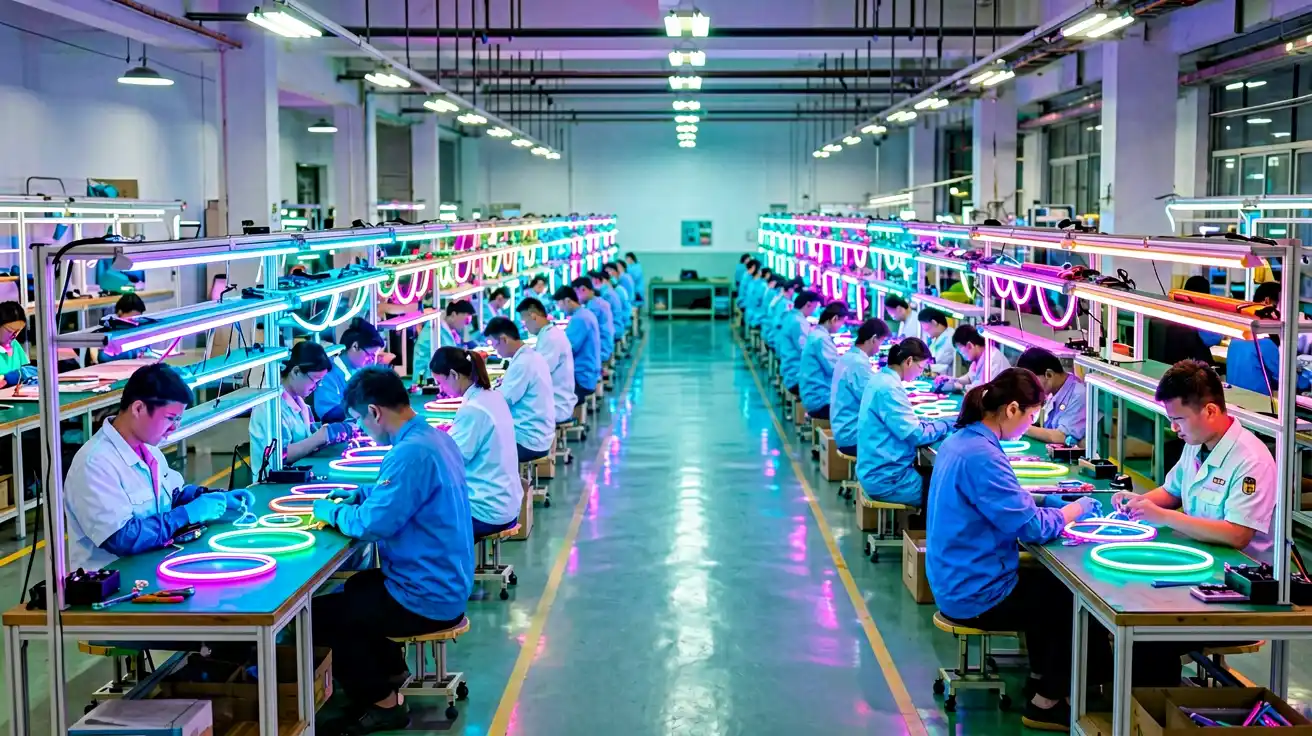
– Request a video call to their workshop. If they refuse, red flag.
– Ask for recent client references (same industry as you)
– Check their certifications (UL, CE, RoHS) — not for decoration, for actual compliance
– See if they offer a free design proof before production starts
– Ask about their rejection rate and what happens if your order arrives damaged
3. MOQ doesn’t have to scare you.
A lot of people think MOQ means “only big brands can order.” That’s outdated thinking. Many modern OEM neon sign manufacturers offer MOQs as low as 1 piece for custom orders. If a supplier tells you the MOQ is 50+ and won’t budge, that’s a warning sign. You want someone flexible enough to grow with you.
That said, higher MOQs sometimes unlock better per-unit pricing. It’s a trade-off. Use a comparison like this to decide:
| Order Size | Typical Per-Unit Cost | Best For |
|—|—|—|
| 1–5 pcs | Premium per unit | One-offs, samples, small tests |
| 6–20 pcs | Mid-tier pricing | Growing retailers, pop-ups |
| 21–50 pcs | Volume pricing | Established resellers |
| 50+ pcs | Factory wholesale | Large retailers, distributors |
4. The quality checklist (don’t skip this):
When a manufacturer sends you a sample or quote, check these 9 things:
– LED strip density (should be 60+ LEDs per meter for even glow)
– Silicone tube thickness (2mm minimum for outdoor signs)
– Backing board material (aluminum channel preferred over plastic)
– Transformer/plug quality (UL/CE listed, proper voltage match)
– Color accuracy vs. your proof (request a color swatch photo)
– Seam/hide visibility (joints should be nearly invisible)
– Mounting hardware included (standoffs, chains, or both)
– Warranty terms (minimum 2 years)
– Response time to issues (ask specifically — “How long do replacements take?”)
5. Questions every buyer should ask a factory:
Here’s the script I wish I had before my first order:
– “Can I see your actual production line, not just showroom photos?”
– “What’s your typical lead time from proof approval to shipment?”
– “Do you offer 3D design tools or do I need to provide final artwork?”
– “What’s your defect replacement policy?”
– “Can you ship to [your country] and handle customs documentation?”
– “Do you provide installation guides and hardware?”
– “What certifications do your products carry?”
– “Can I place a sample order first before committing to volume?”
My honest takeaway: the manufacturer you choose will shape your entire customer experience. A bad factory will cost you more than the price difference — in returns, frustrated customers, and lost referrals. Take your time vetting.
142 upvotes · Reply · Share
u/NeonNerd_Dan · 67 points · 3 months ago
Adding to this — and I’m not here to sell anything, just sharing hard-earned lessons.
The “custom neon OEM suppliers with design tools” thing matters way more than most buyers realize. I worked with a factory that claimed to have a design tool but actually just sent me a blank PDF and told me “fill in your own.” Took 3 weeks of back-and-forth just to get a proof.
A proper OEM supplier will give you:
– Online design configurator (pick size, color, font, layout)
– Free vector-to-neon conversion
– Digital proof within 24-48 hours
– Revision rounds included (usually 2-3)
This isn’t a luxury — it’s how you avoid spending $800 on a sign that looks nothing like what you imagined.
Also, the “neon sign manufacturers USA” search term — fair warning. Most results are either dropshippers rebranding Chinese factory signs or actual US workshops with 8-12 week lead times and 2-3x the price. Neither is wrong, but know what you’re getting into. If speed matters, overseas OEM is usually the smarter pick for cost and turnaround.
56 upvotes · Reply
u/RetailRen · 54 points · 3 months ago
I run a small gift shop and was terrified of MOQs. Turns out most neon sign manufacturers suppliers are totally fine with 5-10 piece minimums. I started with 8 signs (mix of our best sellers in different colors) and now I’m ordering 30+ per month.
The key was finding someone who treats small orders like small orders, not like mistakes. Some factories pretend to be flexible on MOQ but then nickel-and-dime you on setup fees. Read the fine print.
Also — and this took me forever to learn — always, always order a physical sample before your first bulk order. The colors in the digital proof don’t always match the actual product. I’ve seen it happen twice. Cost you $150 in sample shipping but saved me $2,000 in a bad batch.
38 upvotes · Reply
u/ShopFrontSara · 41 points · 3 months ago
As someone who’s been in the signage business for 8 years, here’s the unglamorous truth: quality control is everything.
I’ve seen buyers save $300 on an order and then spend $800 fixing defects, dealing with returns, and re-ordering. The manufacturer who charges $50 more per sign but has a 98% first-pass yield will always be cheaper in the end.
Two things I check that most people miss:
1. The power supply — cheap signs use cheap transformers that hum, flicker, or die in 6 months. Ask about the brand and warranty on the driver.
2. The silicone jacket — outdoor signs need UV-stabilized silicone. Cheap silicone yellows and cracks in a year.
If a manufacturer won’t tell you the specs on these two components, find another one.
31 upvotes · Reply
u/BrandBuilderAlex · 29 points · 3 months ago
I went through this exact process for my boutique. Started with a trading company because it was easier to find on Google. Ended up paying 35% more and got zero communication when I needed changes.
Swapped to an OEM manufacturer the next order. The difference was night and day — video calls, real-time updates, and they caught a font sizing issue in the proof that would’ve been a $600 mistake.
Pro tip: don’t just ask for a photo of the sign. Ask them to record a 30-second video with your order number visible. If they’re a real factory, they’ll do it. If they make excuses, run.
22 upvotes · Reply
u/CoastalLights · 18 points · 3 months ago
Great thread. One thing to add: shipping and customs.
If you’re importing, the manufacturer should handle export documentation (commercial invoice, packing list, certificate of origin). Some will, some won’t. Get clarity before ordering, or you’ll get stuck at customs and pay fines.
Also — packaging quality matters more than you think. I once got a shipment where 3 out of 12 signs arrived with cracked silicone at the joints. The factory repacked and resent them free, but it cost me 2 weeks of empty shelf space. Good packaging = fewer headaches.
14 upvotes · Reply
u/DesignDrivenJen · 12 points · 3 months ago
I’m glad this thread exists. I was about to place a $1,200 order with a company that had zero reviews and no certifications listed. Stopped myself, came here, and now I’m 3 weeks into a smoother process with a vetted OEM supplier.
The “questions to ask a factory” section is gold. I’ve bookmarked it and sent it to my business partner.
Also — if anyone’s looking for product examples to understand what good quality looks like, check out something like https://www.yneonled.com/product/boss-lady-neon/ or https://www.yneonled.com/product/limited-edition-neon/ — just to see how professional product pages present their signs. It gives you a benchmark for what to expect.
9 upvotes · Reply
—
Key Takeaways
– OEM manufacturers beat trading companies on price, communication, and quality control — but verify with video calls and references
– MOQs as low as 1 piece are available; don’t let a high minimum scare you away from a good fit
– Use a 9-point quality checklist (LED density, silicone thickness, transformer quality, warranty, etc.)
– Always order a physical sample before bulk — digital proofs lie about color
– The right manufacturer makes you look good to your customers. The wrong one makes you look bad even if the sign itself is fine
– Start with a small test order, then scale — most suppliers respect this approach
Looking for a manufacturer that checks these boxes? Visit https://www.yneonled.com/custom/ to explore our OEM neon sign capabilities.
[Read more: How Custom Neon Signs Are Made — Factory Process and QC](https://www.yneonled.com/blog/business-marketing/how-neon-signs-are-made/)