
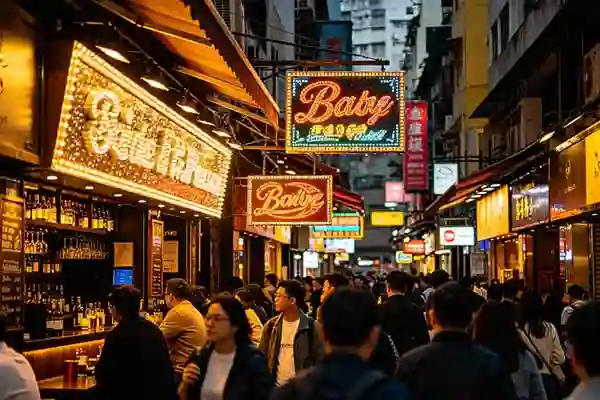
If you run a small bar, a neon sign is one of the few pieces of work you can put on the wall that pays you back in three currencies at once: it makes the venue visible from the street, it sets the mood before anyone has ordered a drink, and it gives customers something worth photographing. The real question is not whether neon looks good. It is whether this sign, in this bar, at this address, earns back what you spend on it — and that is a question you can answer with numbers rather than vibes.
Related products: Selfie Station Neon Sign – LED Social Media Backdrop.
Related products: LED Neon “Welcome” Sign for Storefront Window Glass, LED Neon Cupcake Sign – Wall, Welcome Neon Sign – For Home Business Entryway & Front Door.
Below is the same cost, running-cost and placement thinking we walk bar owners through when they order from us directly as the manufacturer. Nothing here is a marketing claim dressed up as data; it is the arithmetic that decides whether a neon sign is an investment or a decoration.
What does a neon sign actually cost for a small bar?
For the kind of signs that fit a small bar, the price band is narrower than most owners expect. A custom LED neon sign for a bar typically runs $150 to $500, and where you land inside that band is driven by size and how complicated the outline is — not by colour, which is free to change.
| Size | Typical use in a small bar | Price band |
|---|---|---|
| Small (up to ~24 in) | Back-bar shelf accent, one-word piece, bathroom mirror | $150–$250 |
| Medium (~24–36 in) | Window sign, photo wall, booth backdrop | $250–$350 |
| Large (~36–48 in+) | Entrance statement, main feature wall, logo mark | $350–$500 |
Two things push you to the top of a band: a multi-colour logo with several separated shapes (each shape is its own piece of neon and its own mount), and unusual proportions such as a very long, thin script line. Two things do not push the price up: swapping the colour of the light, and choosing a font from the standard library. If your bar’s identity is built on a specific typeface, that is worth checking before you approve a proof — see our custom neon sign size guide for how to match letter height to viewing distance so the sign stays readable from the pavement.
This is a one-time cost. That matters, because every alternative on this list — a repaint, a new menu board, a monthly ad budget — either recurs or disappears when you stop paying.
LED neon vs traditional glass neon: which one pays for itself in a bar?
Traditional glass neon and modern LED neon are often sold as if they were the same product at different prices. They are not, and for a bar the differences are practical ones.
Traditional glass neon
- Electrified gas sealed inside hand-bent glass tubes.
- Warm, 360-degree glow and a faint nostalgic hum that LED does not perfectly replicate.
- Expensive to build, fragile, and runs on high voltage.
- A single broken tube can take the whole sign out until it is re-bent by hand.
LED neon
- Flexible LED strips set inside a silicone or acrylic channel.
- Significantly cheaper, consumes roughly 80% less energy than glass neon, and is virtually shatterproof.
- Runs on a low-voltage adapter rather than mains voltage inside the sign.
For a small bar on a tight budget, LED wins on almost every axis that matters: it survives a rowdy Friday night, it is gentler on the monthly utility bill, and if you ever want a different look you can replace the sign rather than repair it. Glass neon still has a place — a heritage frontage, a period interior, a single statement tube — but that is a design decision, not a financial one. If you want the full side-by-side, we break it down in LED neon vs glass neon.
How much does a bar neon sign cost to run every night?
Running cost is where LED neon quietly beats every other lit sign a small bar could choose, and it is also where owners most often overspend by accident.
- Low-voltage operation. An LED neon sign runs off a small 12V adapter, not mains voltage inside the sign body. The consumption is a fraction of an equivalent glass tube sign.
- Hours matter more than size. Most bars only need the sign lit for opening hours. If you would otherwise leave it on around the clock, switching to a 5–6 hour evening window cuts its energy use by roughly three quarters — with no loss of street presence, because nobody is walking past at 4am anyway.
- The adapter is the wearing part. On LED neon signs, the power brick or transformer is the component that tends to fail first, often after two to three years of nightly use. It is a small, replaceable part — budget for it rather than replacing the whole sign.
- No consumables. There is no gas to refill and no tube to re-bend. Once the sign is up, the recurring cost is essentially electricity plus the occasional adapter.
The practical takeaway: a bar neon sign is not a line item that grows. It is a fixed cost with a small, predictable running tail — which is exactly what you want from a piece of signage.
Does a neon sign really bring in more customers?
Direct attribution is hard — nobody can tell you the exact customer who walked in because of the sign. But the indirect effects are consistent and they compound.
Walk-ins from the street
A bright sign in a window makes an entrance look open, alive and established, which is what turns a passer-by into a first visit. Signs placed in windows or above entrances capture several times more attention than a sign on an interior wall that nobody outside can see.
Dwell time and per-tab spend
Good lighting makes a room feel intentional. People linger in rooms that look finished, and people who linger order one more round. That effect is felt every single night, not once.
The photo engine
A neon sign is effectively a user-generated content machine. When a customer photographs a witty glowing line and posts it, that is free advertising to their own followers — reach you did not pay for and could not have bought as efficiently. It is the single strongest argument for treating the sign as an asset rather than an expense.
We look at this in more depth in do neon signs increase sales, including how owners think about measuring an effect that is real but diffuse.
Where should you hang a bar neon sign for the best return?
Placement changes the return on the same sign more than any other decision, and it is free to get right.
- Window or entrance first. If you only ever buy one sign, put it where the street can see it. A sign the public cannot see is a decoration, not an investment.
- Photo wall second, at eye level or slightly above. This is the spot that gets photographed. Hang it at roughly standing eye height so a phone held naturally frames it, and leave the wall around it plain.
- Give it a clean background. A busy backdrop makes the light read as noise. Contrast — a bright line against a dark or neutral wall — is what makes a sign pop in both the room and the camera roll.
- Do not overcrowd. One well-placed sign reads as a design choice. Three competing signs read as clutter and split the attention you paid for.
If space is tight, the same rules still apply — the trick is choosing a smaller sign and a single strong spot rather than a bigger sign in a worse one.
What should a small bar’s neon sign say?
Copy is free to change and it decides whether the sign becomes a photo moment or gets ignored.
- Keep it to three to five words. Short lines are read at a glance from across a room and photograph cleanly.
- Be specific to your crowd. Small bars live on personality. A line that only makes sense in your bar beats a generic greeting every time.
- Match the light to the wall. A colour that fights the paint reads as muddy in photos, and photos are the whole point.
- Avoid the obvious. The word “BAR” in a window is fine but forgettable; a line people repeat to friends is an asset.
For a long list of proven lines and the reasoning behind them, see bar neon sign ideas.
The hidden costs nobody warns you about
The price on the quote is not the full cost of owning a sign. These are the items that surprise owners:
- Mounting. A sign has to be fixed so it cannot fall on a customer or a staff member. Budget for proper mounting hardware and, if your walls are awkward, for someone to fit it.
- The adapter, again. Treat the transformer as a consumable on a two-to-three-year horizon rather than a permanent part.
- Electricity if left on 24/7. Efficient is not the same as free. Put the sign on the same switch schedule as your lights.
- Moving costs. If you relocate, the sign comes with you only if it was designed and mounted to be removable. Bars planning to move within a year should say so at the design stage.
- Changing your mind. A sign built for one wall rarely fits the next one. Decide the permanent spot before you order, not after.
Our neon sign pricing guide walks through how each of these shows up in a real quote so there are no surprises after delivery.
How does a neon sign compare with paid marketing?
This is the comparison that makes the decision for most small bars. A custom LED neon sign sits at roughly $150–$500, once. Compare it with what the same money buys elsewhere:
| Option | Cost | Stops working when you stop paying? |
|---|---|---|
| Custom LED neon bar sign | $150–$500 one-time | No — works every night, year after year |
| Local digital ad campaigns | $300–$1,000 per month | Yes — impressions end the moment the budget does |
| Printed flyers / menu drops | $100–$300 per campaign | Yes — one campaign, one burst of attention |
| Signage refresh / rebranding | $200–$500 every few years | Only when you spend again |
Then look at impressions. A sign in a moderate-footfall location can generate roughly 500–2,000 impressions a day, which is on the order of 180,000–730,000 a year — for a one-off cost, with no daily budget attached. Set against typical paid advertising rates, that is a cost per thousand impressions that paid channels simply cannot match, and it is the core of why we treat signage as a marketing line rather than a decorating line. Our commercial neon ROI analysis works the same numbers through in more detail.
When a neon sign is NOT the right investment
There are honest cases where a small bar should not spend on signage first:
- Very low foot traffic. A quiet residential street or a basement with no street visibility gives a window sign little to work with. Signage amplifies an audience; it does not create one.
- A start-up budget under about $1,000. At that level, essential equipment comes before decoration. Wait until the bar is trading.
- A planned move within 6–12 months. Either choose a portable, easily remounted sign or postpone the spend until you are in the permanent space.
Even in these cases a small, well-placed interior sign can still earn its keep by lifting how long people stay and how much they spend per visit — it just will not be carrying the customer-acquisition load.
A 60-second decision checklist for small bar owners
- Can the street see where I would hang it? If no, reconsider the spot before the sign.
- Is my budget at least $150 for the sign itself, plus a little for mounting?
- Do I have one clean wall for a photo moment?
- Can I put the sign on my opening-hours lighting schedule rather than 24/7?
- Am I staying in this venue for more than a year?
- Do I have a line of three to five words that sounds like my bar and nobody else’s?
Six yeses means the sign is a straightforward investment. A few noes does not mean never — it usually means changing the placement or the timing rather than abandoning the idea.
Our take, as the manufacturer
We build these signs, so treat this as bias if you like — but the advice we give bar owners is consistently to buy fewer, better signs. One well-made LED neon sign in the right spot will out-perform three cheap flickering ones, both in how the bar looks and in what it earns back. Quality over quantity is not a slogan here; it is the difference between a sign that still looks intentional in five years and one that becomes a maintenance job.
The sign that works is the one that is visible, photographed, and switched on every night you are open. Everything else is decoration.
Looking for the right piece for your venue? Take a look at our collaboration neon sign, our “be yourself” neon sign, or our hustle & heart neon sign to see the sizes and finishes we build most often for bars and hospitality spaces.