
What Makes a Bar Neon Sign Worth the Wall Space?
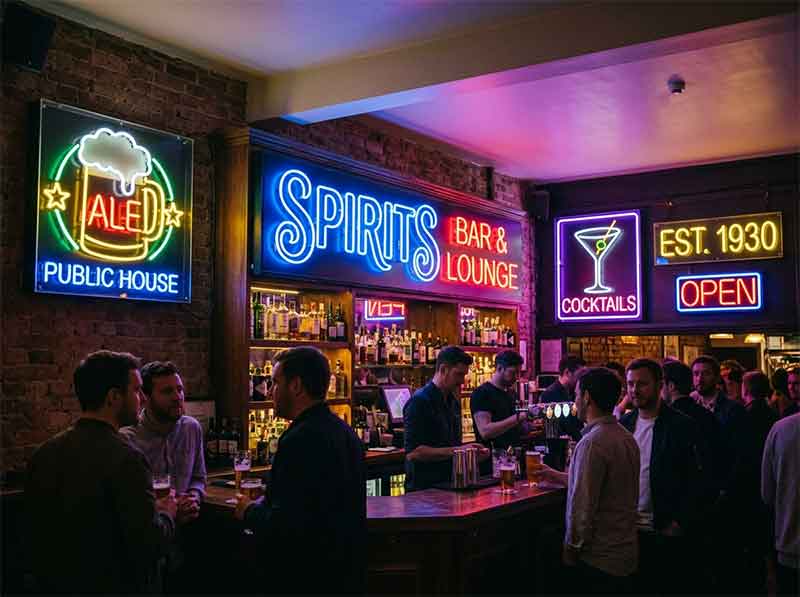
A bar sign has two jobs most signage can only half-do. In daylight it has to say what the venue is to someone walking past on the far side of the street. After dark it has to carry the room, because that is when customers arrive and when the light sets the mood for you. LED neon does both from a single panel — a light source and a brand asset in one piece of acrylic.
Related products: LED Neon “Welcome” Sign for Storefront Window Glass, LED Neon Cupcake Sign – Wall, Welcome Neon Sign – For Home Business Entryway & Front Door.
We build bar signs for pubs, cocktail lounges, sports bars and nightclubs every week, and the same pattern repeats: venues that photograph well have one strong, well-placed neon piece rather than five small ones scattered across the walls. That sign becomes the backdrop for every group photo taken on the premises. For the wider argument, read our piece on why bars thrive on neon lighting.
15 Bar Neon Sign Ideas, Sorted by Venue Type
1. The Classic “BAR” Sign
Three letters, no explanation needed. A “BAR” sign in red, warm white or blue is the anchor piece for a venue with no other strong signage. Build it large and window-facing on a busy street; go smaller for the back-bar wall if your frontage is already busy. Keep the letterform heavy — a block font reads from 20 metres at night, a thin script does not.
2. The “Open” Sign for the Front Window
An “Open” sign removes the biggest friction point for a first-time visitor: not knowing whether the door is a way in. Mount it at eye level in the window, not above the doorframe where the pavement cannot see it. Battery-operated versions suit pop-ups, festival bars and patios with no permanent outlet.
3. Beer Mug and Hops Icons
A frothy beer mug or hop cone in amber LED says “pub” before anyone reads a word. These work hardest for craft breweries, taprooms and traditional English-style pubs where the beer list is the draw. Pair the icon with your establishment name so the piece doubles as branding. Amber and warm white are the natural choices here.
4. Martini or Cocktail Glass Silhouette
For a cocktail lounge the silhouette does the work. A martini or margarita glass in slim, continuous line reads as premium where a text sign can read as generic. Above the bar or on the lounge wall both work; white, gold or soft pink suits a dark interior, and leaving the glass unfilled keeps the lines clean.
5. “Cheers” Above the Bar Rail
“Cheers” is the most photographable word in hospitality, and that is the entire business case. Mount it behind the bartender, above the rail, or on a booth wall so guests naturally raise a glass in front of it. It works in almost any colour, which makes it the safe pick when your interior palette is still undecided.
6. Whiskey and Bourbon Script
A “WHISKY” or “BOURBON” piece speaks to a specific clientele and justifies a higher price list. Warm amber or gold echoes the liquid and sits naturally against leather, dark timber and low light. These read best as script or serif wordmarks rather than block fonts — the piece is doing an atmosphere job, not a wayfinding one.
7. Happy Hour Time Sign
“Happy Hour 5–7pm” in neon is decoration and promotion in one purchase. The time stays legible from across the room, so the offer keeps working after the table tents are cleared away. Put it where people decide whether to stay for one more — near the bar or above the till. Update it for seasonal offers rather than running the same window all year.
8. “Last Call” for the Closing Shift
A retro “Last Call” gives regulars a running joke and the room a personality a chain venue cannot copy. Traditional red reads nostalgic; warm white reads modern-classic. Mount it near the exit or over the bar where end-of-night conversation happens, and switch it on only for the last hour so it lands as an event.
9. Photo-Wall Phrases
A large phrase — “Good Times”, “Late Nights”, “Drink Up” — on a dedicated feature wall is a content machine: guests photograph it, tag the venue and post it. Give it its own wall with clear floor space in front so people can stand back far enough to frame the sign plus themselves. 120–180cm wide is the usual sweet spot for group photos.
10. Wine and Cocktail List Signage
In a wine bar or upscale lounge, “WINE” or “COCKTAILS” in an elegant script lets guests navigate without flagging down staff on a packed Friday. Place them above separate service points so the sign divides the room into zones instead of competing for the same attention. Soft pink or white suits a wine bar; a cocktail lounge can carry something bolder.
11. Your Pub Name Behind the Bar
The name in neon on the back-bar wall appears in every photo taken at the counter, which makes it the highest-value branding position in the building. 100–150cm wide fits most back-bar walls without crowding the spirits shelf. RGB versions let you change colour for holidays, match a guest tap takeover, or dial the piece back when the room is quiet.
12. Sports Bar Team and Match-Night Signs
Team names, “GOAL” or a club crest in team colours turn a generic sports bar into a home ground on match day. Because the viewing area is one long wall of screens, several smaller pieces spread around the room beat one large piece in the middle — the colour should be visible from every seat. For the higher-brightness end of the range, see our nightclub neon sign guide.
13. Patio and Beer Garden Signs
Outdoor neon extends your branding to the pavement and helps guests find seating they did not know existed. Use weatherproof LED neon with a proper IP rating for patio walls, pergolas and fences, and keep the text short — “PATIO”, “BEER GARDEN”, “ROOFTOP”. The specification details that matter outdoors are in our outdoor neon IP ratings guide.
14. Directional and Wayfinding Neon
“BAR →”, “RESTROOMS →”, “ROOFTOP ↑” in neon removes friction and looks intentional doing it. These earn their place in multi-level venues, split-level clubs and hotel bars where guests would otherwise ask staff for directions all night. Keep them 40–60cm wide and mount them at the junction where the decision is made, not at the destination.
15. The Inside-Joke Sign
A house phrase, a regular’s nickname, a running gag from the bar’s own history — this is the sign that turns customers into regulars, because it signals the venue has a personality. Put it where regulars claim it as their own: the end of the bar, the smoking area, the corner booth. Chains cannot replicate it, which is the point.
What Size Bar Neon Sign Do You Actually Need?
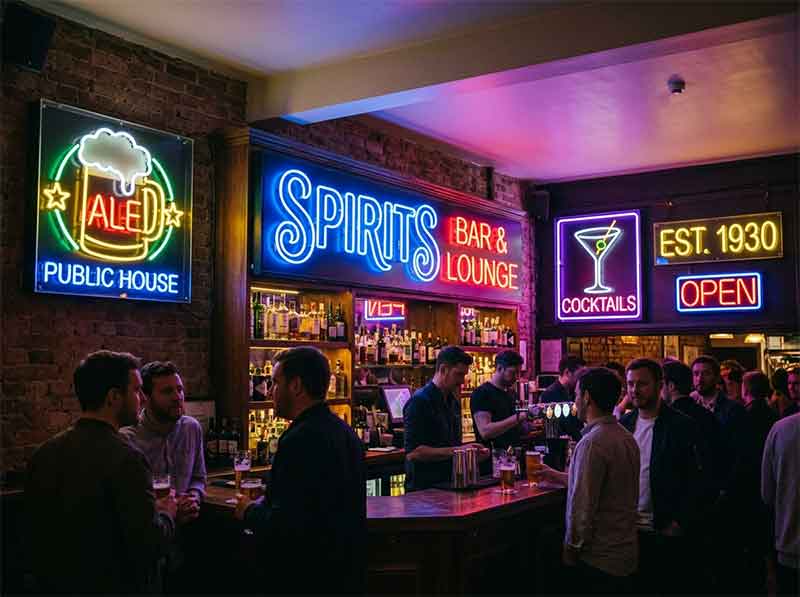
Size is decided by viewing distance, not wall size. A sign read from 3 metres can be half the width of one read from 8 metres. As a working rule, the sign’s longest dimension should be about one tenth of the reading distance in centimetres — a 5-metre read wants a 50cm-wide sign minimum, and 90cm if you want it to be the feature.
| Placement | Typical Width | Why |
|---|---|---|
| Back-bar wall (pub name, BAR) | 100–150cm | Read from every seat; sits above the spirits shelf |
| Front window / street-facing | 60–120cm | Read from the pavement; larger only if glazing is deep |
| Photo / feature wall | 120–180cm | Must fit a person standing in front of it in one frame |
| Patio, fence or pergola | 60–90cm | Seen at an angle from the street; keep the phrase short |
| Directional / wayfinding | 40–60cm | Read from 2–3 metres at a decision point |
| Above a booth or table | 30–50cm | Intimate scale, read from under 2 metres |
Two constraints override the table. Back-bar walls usually have a shelf line and a ceiling to clear, so measure the clear space first. And anything past roughly 120cm wide in a single panel becomes awkward to ship and harder to level — oversized pieces are often better built as two joined panels. Our neon sign size guide walks through the measurement method.
How Bright Should It Be, and What Colour?
Brightness and colour are the same decision in a bar, because both set how long people stay. Low-lit cocktail lounges want a softer output — warm white, amber or one deep tone — so the sign glows rather than glares. Sports bars and clubs want higher output and saturated colour, because the sign competes with televisions, projectors and stage lighting.
- Warm white and amber — the default for pubs, whisky bars and lounges. Flattering on skin in photographs, which matters more than most owners expect.
- Red — highest impact from the street and the classic bar signal; best for “BAR”, “Last Call” and late-night venues.
- Pink, gold and white — the cocktail and wine bar palette; reads premium against dark interiors.
- RGB (colour-changing) — for venues that switch mood between day and night: brunch brightness at noon, club tones after 9pm, brand colour on event nights.
- Team colours — fixed single-colour pieces usually beat RGB in sports bars, because the colour must be correct at a glance.
If the sign sits behind the bar where staff work all shift, ask for a dimmable build. A piece that is perfect at 11pm can be uncomfortably bright during a 4pm service, and dimming is far cheaper than replacing it later.
Where to Hang It: Heights and the Mistakes to Avoid
The four positions that earn their money in a bar are behind the bar (every customer faces it), the front window (attracts foot traffic), a feature wall (photo backdrop), and above the entrance (defines the space). Working mounting heights for a standard 2.7–3m bar ceiling:
- Back-bar sign: centre at 1.8–2.2m, clearing the tallest shelf and staying above staff head height.
- Window sign: 1.4–1.7m to the centre — the eye level of someone on the pavement.
- Photo wall: 1.5–1.9m to the centre so a standing group frames correctly.
- Above a booth: 1.9–2.1m so nobody hits it standing up.
Two mistakes we see most often: placing neon directly opposite a television, where it washes out the screen, and hanging it in a window that takes direct afternoon sun, where the sign is invisible until dusk. Neon should never compete with another light source — give it a wall that is its own.
How Much Power Does a Bar Neon Sign Draw?
Far less than most owners assume, which is what makes neon practical for a venue open until 2am. Our bar signs run on a low-voltage DC adapter rather than mains voltage through the sign itself, which is why they can sit in tight spaces behind the bar without a heat problem.
- Consumption is quoted per metre of tubing, and a typical bar sign draws a small fraction of an equivalent hand-blown glass neon tube.
- The signs produce effectively no heat, so they are safe near spirits shelves, paper menus and fabric banquettes.
- Plug-in adapters suit most interior installs; concealed or hard-wired runs suit a permanent back-bar piece, and dimming adds no load.
Adapters are the one component that ages, so we keep the specification on file for every build.
Will an LED Neon Sign Survive a Busy Bar?
A bar is a hard environment: spills, heat, humidity, cleaning chemicals and constant handling by staff. Our LED neon signs use silicone tubing with the LED strip sealed inside, rated for 50,000+ hours of continuous use. An indoor bar sign running eight hours a night, six nights a week is therefore measured in decades, not seasons.
Three properties matter commercially. They are shatterproof, so a knock from a bar back does not end the sign the way it would with glass. They run cool, which removes the fire-risk conversation with your insurer. And the silicone jacket is wipe-clean — a dry or barely damp cloth with mild soap, no solvents or abrasives. Our guide to cleaning and maintaining LED neon signs covers the routine. Outdoors, the deciding factor is the IP rating, so specify it before ordering.
What Does a Bar Neon Sign Cost?
Cost is driven by size first, then complexity, then colour count. These are the bands we work to for bar-scale pieces; the full breakdown of how each factor moves the number is in our custom neon sign price guide.
| Sign Type | Typical Size | Price Band | Best For |
|---|---|---|---|
| Small word sign | 12×8in | $80–150 | Booths, counters, small windows |
| Standard word sign | 24×16in | $140–220 | “Cheers”, “Open”, happy hour signs |
| Large back-bar sign | 36×24in | $220–350 | Pub name, “BAR”, logo pieces |
| Extra large / feature wall | 48in+ | $350–550+ | Photo walls, street-facing window signs |
| Double-sided | Any | +40–60% | Window-hung pieces read from both sides |
| RGB / remote control | Any | +$30–60 | Venues that change colour for events |
Two things surprise first-time buyers. Every additional colour adds a separate LED run and extra wiring, so a two-colour logo costs meaningfully more than the same design in one colour. And a double-sided build is effectively two signs in one housing.
How to Order a Custom Bar Neon Sign From Our Factory
The process is short because we manufacture rather than resell. Send your text, choose a colour and size, and we return a digital mockup within 24 hours so you can see the piece on your own wall before anything is built. Standard production takes 7–14 business days, with rush builds available at a premium when a launch date is fixed.
Three things to decide before sending the brief: the exact wording (character count is the main cost driver), the mounting position (it sets the size and cable length), and whether the sign must be read from two sides. To skip the design conversation, browse the ready-made bar sign collection for popular designs that ship faster.
Ready to start? Build your piece in our custom neon sign builder and we will send the mockup within a day.
Bar Neon Sign FAQ
Can a bar neon sign be battery operated?
Yes. Battery builds suit temporary bars, festival setups and patios with no permanent outlet. For a fixed back-bar sign a plug-in adapter is simpler and avoids battery changes.
Can you match our brand colour?
Yes — send the colour reference or brand guide with your brief. Colour matching is one reason venues order directly from a manufacturer rather than a marketplace listing with a fixed swatch list.
How long will a bar sign actually last?
The LED is rated for 50,000+ hours of continuous use. In a bar running eight hours a night, the adapter is the part worth keeping a spare of — which is why we hold the specification for every sign we build.