
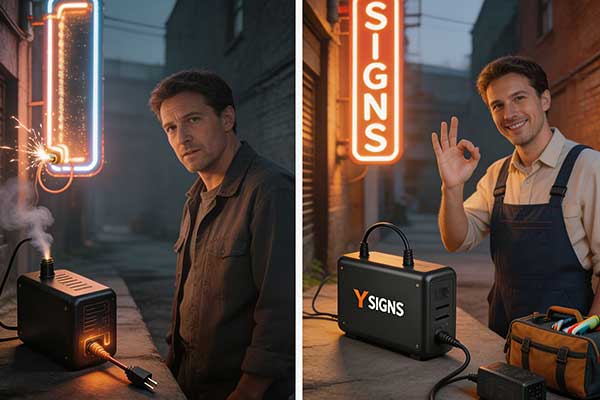
There is one complaint that surfaces more than any other across the custom neon sign industry. It is not dim LEDs, peeling silicone, or delayed shipping. It is power adapter failure. Industry surveys consistently rank power supply burnout as the number one pain point for neon sign buyers. Users report adapters overheating, buzzing, or dying within weeks of installation, leaving a beautiful sign dark and useless. This single component the black box between your wall outlet and your sign is responsible for more returns and more frustration than every other failure mode combined.
The LED neon sign boom of the last five years has flooded the market with sellers competing on price. To hit rock-bottom price points, most cut corners where customers cannot see it: inside the power adapter. This article explains exactly why cheap adapters fail, what separates a reliable power supply from a hazard, and how Y SIGNS engineered a solution that eliminates the industry’s biggest headache.
Why Power Adapter Failure Is the Industry’s Number One Complaint
To understand why adapters fail so often, look at the economics. A complete custom sign might retail for thirty to fifty dollars. At that price, the power adapter costs the manufacturer between two and three dollars wholesale. That two-dollar brick is expected to deliver clean, stable power twenty-four hours a day, seven days a week, often for years. It is an impossible ask.
Roughly seventy percent of neon sign service calls trace back to a dead or failing power supply. The adapter either stops outputting voltage entirely or delivers unstable voltage that causes LEDs to flicker, dim, or burn out. The LED strip inside the sign almost never fails. LED chips rated for fifty thousand hours easily outlast ten cheap adapters stacked end to end. The industry’s most common failure is not the expensive, permanent part inside the frame. It is the cheap, replaceable part that was never designed for the job.
The Anatomy of a Cheap Adapter: Why Two Dollars Cannot Buy Reliability
Inside a power adapter is a circuit built around a transformer, a rectifier, capacitors, and a voltage regulator. Cheap adapters cut costs on every single one.
The Five-Volt USB Charger Problem
The most common failure pattern involves adapters that are not designed for neon signs at all. Many budget sellers simply repurpose standard five-volt USB phone chargers. A phone charger is designed to charge a battery for an hour or two a day. It is not designed to drive a three-meter LED strip for sixteen hours straight. The thermal design, the capacitor ripple rating, and the transformer saturation margin are none of it built for continuous duty.
Running a five-volt USB charger at its rated current for eight consecutive hours pushes internal temperatures past eighty-five degrees Celsius. Electrolytic capacitors lose capacity as they heat up, causing ripple current to increase, causing more heat in a destructive feedback loop. Within weeks, the capacitors bulge, leak, or short. The adapter dies.
Lack of Over-Voltage and Over-Current Protection
A quality power supply includes over-voltage protection (OVP) that shuts down the adapter if output exceeds a safe threshold, over-current protection (OCP) that trips if the load draws too much current, and short-circuit protection that disconnects the output instantly.
Cheap adapters omit these circuits entirely. If a power surge comes through the mains or if the LED strip develops a minor short, there is no safety net. The voltage spikes, the LEDs receive a blast of raw current, and the entire sign can be damaged. In worst cases, an unprotected adapter can overheat to the point of melting its housing or catching fire.
Cheap Capacitors: The Two-Thousand-Hour Lie
The single most important predictor of adapter lifespan is the quality of its electrolytic capacitors. These components smooth the rectified AC into clean DC. Their lifespan is rated in hours at a given temperature.
A bargain adapter uses capacitors rated for two thousand hours at eighty-five degrees Celsius. A sign running twelve hours a day exhausts that rating in roughly five months. After that, the capacitors dry out, lose capacitance, and pass increasing AC ripple to the LEDs. The sign flickers, the LEDs run hot, and eventually something gives out.
Counterfeit and over-labelled capacitors are common in the budget supply chain. A capacitor stamped with false specifications may fail in three months of continuous use rather than the printed rating.
What a Quality Adapter Looks Like: The Twelve-Volt Industrial Standard
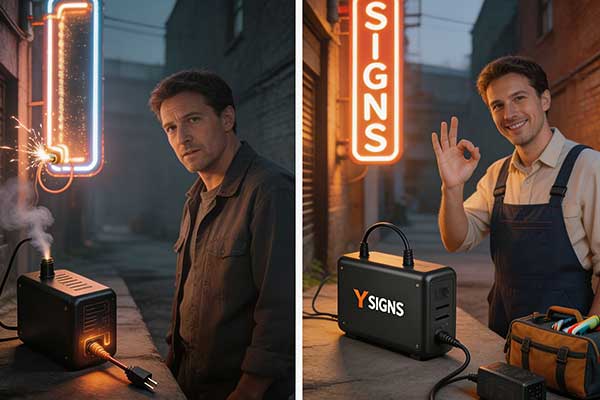
Y SIGNS took a fundamentally different approach. Instead of asking how little an adapter could cost, the engineering team asked what kind of adapter would still be running after five years of daily use. The answer was an industrial-grade twelve-volt architecture.
The first difference is voltage. Y SIGNS uses twelve-volt DC adapters, not five-volt chargers. A twelve-volt system draws less than half the current of a five-volt system at the same power. Lower current means less heat generation in wiring and connectors, and less stress on every component. Twelve volts is also the standard for commercial LED strip lighting, meaning components are built to a known, tested specification.
UL and CE Certification: What the Marks Mean
Every Y SIGNS adapter carries UL and CE certification. These are independent third-party safety certifications requiring rigorous testing for shock, fire risk, and mechanical safety. To earn UL certification, an adapter must survive dielectric voltage withstand tests, abnormal operation tests with the output shorted, temperature rise tests under maximum load, and component failure tests.
CE certification covers electromagnetic compatibility in addition to safety. A CE-marked adapter will not emit radio-frequency interference or be overly sensitive to electrical noise. A two-dollar adapter has never seen a certification lab, and its manufacturer has no documentation to prove otherwise.
Over-Voltage, Over-Current, and Short-Circuit Protection
Every Y SIGNS adapter includes three protection layers. Over-voltage protection monitors output continuously. If a fault causes the output to spike above a safe threshold around thirteen point five volts for a twelve-volt supply the OVP circuit fires and shuts the adapter down.
Over-current protection limits maximum current. If the LED strip develops a partial short or draws more than the adapter supports, the OCP circuit reduces output voltage or shuts down entirely. Short-circuit protection engages within milliseconds if output wires are shorted during installation.
Together, these circuits mean a Y SIGNS adapter survives scenarios that instantly destroy an unprotected supply.
The Capacitor Difference: Ten-Thousand-Hour Components
Y SIGNS adapters use capacitors rated for ten thousand hours at one hundred five degrees Celsius. That is five times the lifespan of the two-thousand-hour capacitors in budget adapters. At typical operating temperatures of sixty to seventy degrees, ten-thousand-hour capacitors last well over a decade. The electrolyte chemistry is more stable, the seals are tighter, and the ripple current rating is higher.
This one specification is the single biggest reason Y SIGNS adapters outlast cheap competitors by a factor of five or more.
Twenty-Four-Seven Continuous Operation Testing
Every Y SIGNS adapter model is tested for continuous twenty-four-seven operation before production approval. The adapter runs under full load in an environmental chamber at forty degrees ambient for a minimum of seven hundred twenty hours. Output voltage, ripple, temperature, and efficiency are logged continuously. Any unit that drifts outside specification is rejected.
Cheap adapters receive no such testing. Many manufacturers spot-test one unit per thousand by plugging it into a sign for thirty seconds.
Comparison Table: Cheap Adapter vs. Quality Adapter
Characteristic Cheap Adapter ($2-3) Quality Adapter ($8-12)
Voltage 5V (USB repurposed) 12V DC industrial-grade
Primary Use Phone charging Continuous 24/7 LED operation
Capacitor Rating 2,000 hours @ 85C 10,000 hours @ 105C
Over-Voltage Protection None Dedicated OVP circuit
Over-Current Protection None Active current limiting
Short-Circuit Protection None Instantaneous disconnect
Safety Certifications None UL and CE certified
Operating Temp Range 0C to 40C -20C to 60C
Expected Lifespan 3 to 6 months 5 to 10+ years
Warranty 30 to 90 days 2 years
Fire Risk Higher Low (multi-layer protection)
How Y SIGNS Ensures Your Adapter Arrives Ready for Years of Service
Each batch of Y SIGNS adapters undergoes incoming inspection checking output voltage under no-load and full-load conditions, ripple voltage on an oscilloscope, and physical inspection of the casing and connectors. During sign assembly, the adapter load is matched to the specific power draw of the sign. Every sign is measured for actual current consumption, and the adapter is rated at least twenty percent above that draw. This derating margin means the adapter never runs at maximum capacity, extending lifespan significantly.
The connector between adapter and sign is a locking barrel jack with a threaded collar rather than a friction-fit connector. This prevents accidental disconnection and eliminates the intermittent contact that causes arcing and heat buildup.
The Business Case: Why Paying More Saves Money
For the customer, the argument is simple arithmetic. A cheap sign costs forty dollars and its adapter fails in four months. If the warranty has expired or does not cover the adapter, the customer buys replacement after replacement. Over three years, they may spend more on adapters than the sign itself cost.
Even with warranty coverage, the customer pays in frustration, troubleshooting time, and sign downtime. A business using a neon sign for its storefront loses marketing value for days or weeks while a replacement ships.
With a Y SIGNS sign, the adapter is warrantied for two years and designed to last ten. The upfront cost is slightly higher, but the total cost of ownership over five years is dramatically lower. This is the same logic driving commercial buyers to specify industrial power supplies for their LED installations.
Compare our warranty coverage in our Warranty Guide to understand how product protection differs between cheap and quality signs.
For more on overall electrical safety, read Are LED Neon Signs Safe and our Lifespan and Warranty guide.
Browse our collection of premium signs featuring industrial-grade power supplies, such as the Hello We Are Open Neon Sign and the But First Coffee Neon Sign.
Frequently Asked Questions
Can I replace a failed cheap adapter with a Y SIGNS adapter on an existing sign? In many cases, yes, provided the sign is designed for twelve-volt input. Check the voltage rating of your LED strip. Most Y SIGNS adapters are twelve-volt, so compatibility depends on the sign. Contact Y SIGNS support with your sign details if unsure.
How do I know if my adapter is UL certified? Look for the UL mark on the adapter label the letters UL inside a circle, or the words “Listed” or “Recognized.” Search the UL online directory using the model number. No mark means no independent safety testing.
What should I do if my adapter gets hot? Some warmth is normal. An adapter at full load may reach forty to fifty degrees Celsius. If it is too hot to hold or you smell burning plastic, disconnect the sign immediately and contact support.
Does leaving my sign on 24/7 reduce its lifespan? The LED strip is rated for fifty thousand hours regardless of usage. With a quality twelve-volt adapter designed for continuous duty, 24/7 operation is safe and does not meaningfully reduce system lifespan. With a cheap five-volt adapter, continuous operation accelerates failure.
Power adapter failure is the number one complaint in the neon sign industry because the market is flooded with two-dollar adapters never designed for the job. They use five-volt USB chargers, capacitors rated for two thousand hours, and zero protection circuitry. They fail in weeks or months, taking your sign down with them.
Y SIGNS fixed this problem by engineering around it. Every sign ships with a twelve-volt UL and CE certified industrial-grade adapter including over-voltage, over-current, and short-circuit protection, capacitors rated for ten thousand hours, and continuous 24/7 operation testing. The result is a power supply that outlasts cheap alternatives by five to ten times, backed by a two-year warranty.
When you invest in a custom neon sign, the power supply should be the last thing you worry about. With Y SIGNS, it is.