
If you’re shopping for a custom neon sign, safety is probably on your mind. Can LED neon signs catch fire? Are they safe for a nursery? What certifications should you look for? These are smart questions — and the answers are reassuring.
This guide covers how LED neon works, real fire risk, silicone vs PVC materials, the certifications that matter, and what to check before hanging a sign in a baby’s room.
How LED Neon Signs Work (And Why They’re Different)
Traditional glass neon signs use high-voltage electricity (3,000–15,000 volts) to excite gas inside fragile glass tubes. They run hot, can shatter, and require professional installation.
LED neon signs — like every sign Y SIGNS produces — use a different technology: low-voltage LED strips (typically 12V or 24V DC) embedded in flexible silicone tubing, an acrylic backing board for support, and a standard wall-plug adapter (like your laptop charger).
So: no high voltage, no glass, no gas, no heat. The sign runs on the same 12V power as your home router, and LEDs convert roughly 95% of the energy they draw into light rather than heat — so a sign can run 12 hours and still sit at only 25°C to 30°C (77°F to 86°F), well below the threshold for skin burns.
For the full breakdown of voltage, heat, lifespan and running cost, see our LED vs glass neon comparison.
Fire Safety: Can LED Neon Signs Catch Fire?
The Short Answer: Extremely Unlikely
LED neon signs operate at low voltage and produce negligible heat. Unlike traditional neon (which can reach 40–50°C on the glass surface), LED neon stays cool to the touch — typically 1–3°C above room temperature.
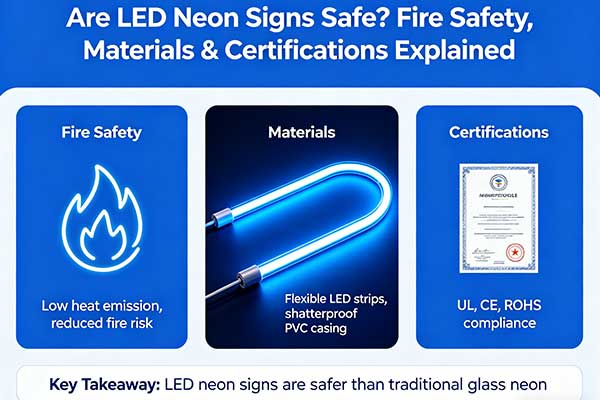
Here’s why fire risk is minimal:
| Risk Factor | Traditional Glass Neon | LED Neon (Y SIGNS) |
|---|---|---|
| Operating Voltage | 3,000–15,000V | 12V or 24V DC |
| Surface Temperature | 40–50°C | Room temp +1-3°C |
| Material | Fragile glass tubes | Flexible silicone/PVC |
| Shatter Risk | High — glass under pressure | Zero — no glass used |
| Fire Risk | Moderate (transformer heat) | Negligible |
Use the provided adapter, don’t modify the wiring, and a quality LED neon sign is one of the safest decorative lighting options you can buy — safer than string lights, candles, or halogen lamps.
Material Safety: Silicone vs PVC, Mercury and VOCs
Fire is only half the story. The other half is what the sign is made of — and that matters most in a child’s bedroom.
Why Traditional Glass Neon Is Not Safe for Kids
“Real” neon is a high-voltage laboratory experiment hanging on a wall. For a child’s room it presents five problems:
- Mercury content: many traditional tubes — especially blue or green ones — contain liquid mercury to brighten the light. If a tube breaks it releases mercury vapour, a potent neurotoxin, into a confined sleeping area.
- Fragility: one accidental hit can shatter a glass tube into hundreds of razor-sharp shards.
- Argon and noble gases: not toxic in tiny amounts, but the high-pressure gas is a hazard if the glass shatters.
- Lead-soldered joints: older or low-end traditional signs often use lead-based solder, a risk if touched by curious hands.
- Voltage: glass neon needs transformers stepping electricity up to 3,000–15,000 volts — an unnecessary risk where children sleep.
The PVC Problem: Off-Gassing, VOCs and Phthalates
Not every LED sign is automatically safe. Cheap ones often use PVC (Polyvinyl Chloride) housings, which can off-gas Volatile Organic Compounds (VOCs) and may contain phthalates — linked to endocrine disruption in developing children.
The Silicone Solution: Food-Grade, Inert and Flame-Retardant
Premium brands use high-quality, flame-retardant silicone instead. Silicone is chemically inert: it doesn’t leak toxins into the air even when warmed by the LEDs. It is the same material as baby bottle nipples and kitchenware.
Material Safety and Air Quality Compared
| Feature | Traditional Glass Neon | Cheap PVC LED Neon | Premium Silicone LED Neon |
|---|---|---|---|
| Material Toxicity | High (Mercury/Lead) | Medium (Phthalates/VOCs) | Non-Toxic (Inert) |
| Shatter Risk | High (Sharp Glass) | None (Flexible) | None (Flexible) |
| Heat Emission | High (60°C+) | Low (30°C) | Minimal (25°C) |
| Off-Gassing | No | Yes (Chemical smell) | No (Odourless) |
Key data: testing cited in 2025 found premium silicone LED strips emitted 98% fewer VOCs over 24 hours than standard PVC-housed electronics — which is why we recommend fully encapsulated silicone for any nursery.
Certifications: What to Look For When Buying
Not all neon sign manufacturers follow the same standards. Here are the certifications that matter — and every Y SIGNS product carries all of them:
✅ CE (Conformité Européenne)
The CE mark confirms compliance with EU health, safety and environmental standards — required for sale in the European Economic Area.
✅ UL (Underwriters Laboratories)
UL is the North American gold standard: independent testing for fire, electric shock and mechanical hazards. Look for UL-listed power adapters.
✅ RoHS (Restriction of Hazardous Substances)
RoHS compliance means no lead, mercury, cadmium or other restricted hazardous materials — especially important in a nursery or bedroom.
✅ FCC (Federal Communications Commission)
FCC certification ensures the electronics don’t cause harmful interference — your sign won’t disrupt your WiFi, baby monitor or Bluetooth speakers.
A Five-Point Shopping Checklist
- RoHS compliant — free from lead, mercury and cadmium.
- BPA-free / phthalate-free — important if the sign is within reach of younger children.
- UL- or CE-certified adapter with overload protection and automatic shutoff — this is what prevents overheating and short circuits.
- Fully encapsulated LED strip — silicone covering the strip completely, with no exposed solder joints or wiring.
- Material safety data sheets on request — reputable manufacturers will share them. If a brand can’t tell you what certifications it carries, move on.
Contact Y SIGNS if you’d like to see our certification documentation — we’re happy to share it.
Are Neon Signs Safe for Babies and Kids’ Bedrooms?
This is what parents actually search for: “Are neon signs safe for babies?” “Shatterproof neon lights for playroom” “Non-toxic LED neon for kids’ bedroom” “Cool-touch night lights with custom names.” The answer is a clear yes — if you choose LED neon rather than glass.
The Short Answer for Parents
A modern LED neon sign is as safe as a standard nightlight while giving the same vibrant glow. To keep it that way:
- Mount it out of reach — at least 1.5m (5 feet) above the crib or floor.
- Secure the power cord behind furniture or in a cable raceway so a toddler can’t pull on it.
- Our signs use 12V DC — the same low voltage as children’s night lights — and stay completely cool.
- All materials are RoHS certified, so no toxic substances are present.
Traditional glass neon, by contrast, should be strictly avoided in a child’s environment.
Child-Safety Features to Look For
- Dimmer or remote: 100% brightness is often too bright for sleeping. A dimmer drops it to around 10% for nightlight use.
- Timer: LEDs are rated for 50,000+ hours, and a timer protects that lifespan by switching the sign off once your child is deeply asleep.
- UL/CE-certified adapter: ensures the power brick itself cannot overheat or short-circuit.
- Warm-white or amber modes: less likely to interfere with melatonin production than bright blue or cool white light.
Bedroom Safety and Utility Compared
| Feature | Traditional Glass Neon | LED Neon Flex |
|---|---|---|
| Material | Fragile Glass | Impact-Resistant Silicone |
| Operating Temp | Hot (50°C – 80°C) | Cool (25°C – 30°C) |
| Toxicity Potential | Mercury / Argon | Non-Toxic Materials |
| Mounting | Professional / Heavy | Easy DIY / Lightweight |
| Power Consumption | High (Expensive) | Low (Eco-Friendly) |
Sustainability note: LED neon signs consume roughly 80% less energy than glass alternatives — a lower household carbon footprint that eco-conscious parents value as much as the safety figures.
Age-Appropriate Design Ideas and 2026 Trends
- Infants and toddlers: soft pastels — pale pink, mint green, lavender — create a calming atmosphere that won’t overstimulate young minds. Simple shapes such as stars, moons, clouds or animal silhouettes grow with your child.
- School-age children: customisable name signs or initials in a favourite colour make the room feel personal.
- Teenagers: bold quotes, music notes, gaming symbols or abstract geometric designs reflect an evolving personality.
Neon isn’t just for names anymore. The dominant 2026 trends are pastel palettes that don’t disrupt circadian rhythms as much as harsh blue light; interactive shapes — dinosaurs, astronauts, clouds — that act as wall art by day and a comforting glow at night; and colour-changing (RGB) units a child can set from an app.
Battery-powered options eliminate cord concerns entirely and fit any height without outlet access. Our nursery and kids’ room neon signs are built to these standards, and the home decor and interior collection covers the rest of the house.
Electrical and Eye Safety: Low Voltage, Flicker and Blue Light
A “non-toxic” environment also means “clean” electricity and light.
- Low voltage (12V/24V): unlike the 10,000+ volts required for glass neon, LED signs run on low-voltage DC — too low to cause a lethal shock even if a wire were compromised, and with no high-voltage ionisation there is no ozone production, a byproduct that can irritate a child’s lungs.
- Flicker-free drivers: quality drivers prevent “invisible flicker,” which in cheap lights can cause eye strain and headaches in light-sensitive children.
- Blue light mitigation: many 2026 signs offer a “Warm” or “Amber” mode, cutting high-energy blue light before bedtime and protecting the natural sleep cycle.
- Diffused light: LED neon is diffused through silicone, which softens it significantly. Even so, avoid placing the sign directly in your child’s line of sight from bed.
Plug-In vs Battery Power: Which Is Safer?
Most people searching for a plug-in neon sign want to know two things: is mains power safe, and can a battery version remove the cord entirely?
- Plug-in (12V/24V DC adapter): the standard for wall signs, and perfectly safe when the adapter is UL/CE certified. Each Y SIGNS sign draws only 12–36 watts — less than a laptop — so a normal outlet is more than adequate. The only real risk is cord management.
- Battery-powered: removes cord concerns entirely and fits any height without outlet access — a real advantage in a toddler’s room. The trade-offs are battery weight, recharge cycles and lower brightness on some models.
For a child’s bedroom, a plug-in sign with a certified adapter and a secured cord gives the best mix of brightness, lifespan and safety. For a shelf or rented space with no outlet nearby, a battery model is a sensible choice.
Safety in Commercial and Outdoor Environments
For businesses, fire safety regulations are strict. Here’s what you need to know:
- LED neon signs are classified as low-voltage electronic devices, not high-voltage lighting fixtures.
- They typically don’t require special permits or electrical inspections (unlike traditional neon).
- In most jurisdictions, 12V LED signs are treated like any other consumer electronic device — but confirm with your local fire marshal.
Browse our business and commercial neon signs — all commercially certified. For outdoor use, our signs suit covered areas (patios, porches, under awnings). Fully exposed installation needs additional weatherproofing, so reach out for guidance before you order.
Installation Safety Tips
Most safety issues come from improper installation, not the sign itself:
- Use the included power adapter. Never substitute a different adapter — mismatched voltage can damage the LEDs or cause overheating.
- Don’t daisy-chain power strips. Each Y SIGNS sign draws only 12–36 watts, so a standard outlet is fine.
- Keep the adapter ventilated. The power brick needs airflow — don’t bury it under a rug or inside a closed cabinet.
- Mount to the right surface. Smooth drywall, glass, tile and finished wood take adhesive mounts; brick, concrete and stone need clips or anchors.
Our installation and care guides cover wall-type-specific mounting, cable management and long-term maintenance.
Common Safety Myths — Debunked
Myth #1: “LED neon signs get hot like traditional neon.” False. LED neon operates at near room temperature. You can touch it after 24 hours of continuous use — it’ll feel barely warm.
Myth #2: “All neon signs are made with toxic materials.” False. Traditional glass neon contains small amounts of mercury and phosphor. LED neon contains no gas, no mercury, and no phosphor. Our materials are RoHS certified.
Myth #3: “You need an electrician to install a neon sign.” False. LED neon signs plug into a standard wall outlet, and mounting takes 5 minutes with basic tools. Thousands of our customers have done it themselves.
Myth #4: “Neon signs are fragile and break easily.” False — for LED neon. Our flexible silicone tubing can be bent, flexed, and even accidentally knocked without breaking. You can literally drop an LED neon sign on a hardwood floor and it will likely bounce. It’s why we can ship worldwide with confidence.
Frequently Asked Questions
Q1: Can the light from a neon sign hurt my child’s eyes?
LED neon is diffused through silicone, which softens the light significantly. Even so, avoid placing the sign directly in the child’s line of sight from bed, and always use a dimmer at night.
Q2: Are there any choking hazards associated with these signs?
Most LED neon signs are mounted on a solid acrylic backing with small screws. Mount the sign high enough that a toddler cannot reach the wires or pull it off the wall, and keep the power cord secured with cord clips.
Q3: How long can I leave the neon light on?
Yes. For the best sleep hygiene, use warm white or red/orange tones at night — they interfere less with melatonin production than bright blue or white light.
Q4: My new LED neon sign has a slight “plastic” smell. Is it toxic?
If it is a cheap PVC sign, that smell is likely off-gassing phthalates. Let it air out in a well-ventilated garage for 48 hours before hanging it in a child’s room. A high-quality silicone LED sign should be virtually odourless from day one.
Q5: Are the acrylic backings used for neon signs safe?
Most LED neon signs use high-quality acrylic (Plexiglass), a safe, stable plastic that does not off-gas at room temperature. For the highest standards, choose aluminium backing panels rather than acrylic — aluminium dissipates heat more effectively and won’t yellow or become brittle with age.
Q6: Can a non-toxic LED sign stay on as a nightlight all night?
Yes, provided it has a dimmer. For sleep health, set the sign to its lowest brightness (around 5–10%) and choose a warm colour like orange or soft red. These wavelengths are far kinder to a child’s circadian rhythm than bright white or blue light.
Why Y SIGNS Takes Safety Seriously
We manufacture every sign in our own Hong Kong facility. We don’t dropship from third-party suppliers — which means we control the entire production process and quality assurance chain. Every sign that leaves our studio goes through a 12-point quality inspection, including LED brightness and color accuracy testing, power adapter safety check, wiring integrity verification, acrylic edge finish inspection, and packaging drop-test simulation.
We built our manufacturing process around quality and safety because we know our signs go into homes, nurseries, weddings, and businesses — places where safety isn’t negotiable.
The Bottom Line
LED neon signs are safe. They’re low-voltage, cool-running, shatterproof, and certified to international standards. Buy from a reputable manufacturer — silicone rather than PVC, UL/CE-certified adapter, RoHS-compliant materials — follow basic installation guidelines, and your sign will be a safe, stunning addition to your space for years to come.
Have a specific safety question? Contact our team — we’re happy to answer.
Ready to design your own safe, certified LED neon sign? Use our custom neon sign builder to create your design, then choose the right backing and adapter for the room it’s going in.