
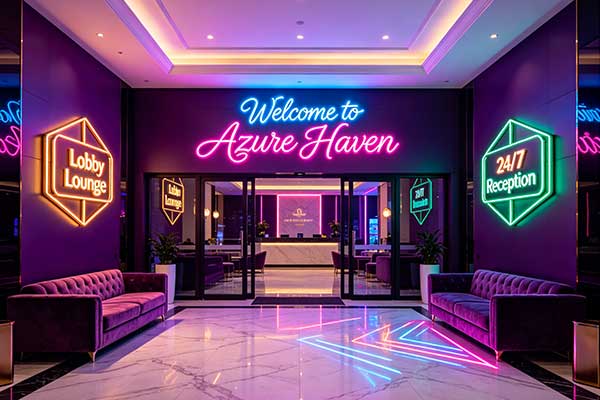
The lobby is where a hotel decides what kind of first impression to make. A hotel lobby neon sign does that faster than almost any other fixture: it is lit, it is photogenic, and it puts the property name or one line of attitude at eye level the moment a guest walks in. The practical question is not whether to have one, but what size, where, what colour, and what it costs to make and run.
This guide is written from the factory side of the order. It covers the numbers we ask clients for before we quote, the placement mistakes we see repeated in hotel lobbies, and the specs that decide whether a sign still looks new after three years of luggage-trolley traffic.
What Size Should a Hotel Lobby Neon Sign Be?
Size follows the wall and the viewing distance, not the design file. Two measurements settle it: how far the guest stands from the sign when they read it, and how much empty wall the sign has to sit in.
As a starting rule, make the sign roughly 60-70% of the width of the panel or joinery it sits above. A sign that fills the whole wall looks cramped; one much narrower than the furniture below it looks like an afterthought. For a standard lobby, 36-60 inches wide reads comfortably from the entrance. In atriums and double-height lobbies, 48-72 inches is the working range, and a vertical format suits a narrow column or the wall between two lift doors because it uses height instead of floor-facing wall space.
Letter height is the other half of the calculation. Allow roughly one inch of letter height for every ten feet of viewing distance, then round up. A name read from 20-30 feet across a lobby needs letter strokes of at least two to three inches to stay legible; a slogan photographed from four to six feet away can go much finer.
| Lobby situation | Typical sign width | Main viewing distance |
|---|---|---|
| Boutique check-in console | 36-48 in | 8-15 ft |
| Standard lobby feature wall | 48-60 in | 15-30 ft |
| Atrium or double-height wall | 60-72 in | 30-60 ft |
| Narrow column or lift lobby | 24-36 in wide, up to 72 in tall | 6-20 ft |
If you are unsure, send us the wall dimensions and a photo; we size the sign against the real proportion rather than guessing from a render. Our custom neon sign size guide walks through the full measurement method.
Where Should the Sign Hang in the Lobby?
The highest-value position is behind or beside the check-in desk, placed so it is visible from the entrance. It catches every arriving guest as they look around for direction, and it doubles as the backdrop for the photo they take while they wait.
- Check-in desk wall. The default. Centre the sign at eye level, around 1.5-1.7 m from the floor to the middle of the design, so it lines up with a standing guest’s sight line.
- Feature or photo wall opposite the entrance. Keep at least 4-6 ft of clear floor in front so guests can step back for a full-body shot, and leave the wall behind plain so the neon is the only thing competing for attention.
- Bar, lounge or all-day café. A second, smaller sign here works harder than a bigger one in the lobby. Warm amber or a saturated colour reads well against dark timber.
- Lift lobby or corridor. Narrow walls suit a vertical sign, giving guests a landmark when they step out of the lift without another printed plate on the wall.
- Covered terrace or pool bar. Only with an outdoor-rated build, discussed under IP ratings below.
One caution: do not mount a lobby sign directly behind the receptionist’s head, a monitor, or a reflective glass panel. The glare lands on the person working underneath it all day, and the reflection doubles the design. Mount it beside the desk instead.
How Bright Should a Lobby Sign Be, and How Much Power Does It Draw?
LED neon is accent lighting, not the room’s primary light source. A hotel lobby sign typically delivers around 300-500 lumens – bright enough to anchor a wall while the surrounding lighting does the general work. If the sign is the backdrop for guest photos, aim for the neon to carry roughly 70-80% of the light on the person, with softer fill from the room.
LED neon flex runs on 12V or 24V DC through a plug-in adapter or a hardwired driver. Most indoor flex draws in the region of 6-12 watts per metre, so even a 1.5 m lobby sign is a small load that can usually share an existing lighting circuit. Two practical points:
- Ask for dimming. A dimmable driver with a wall dimmer or remote lets the sign drop to a soft glow overnight and lift to full brightness for evening arrivals.
- Plan the driver location. It has to live somewhere accessible – a service cupboard, ceiling void or removable panel – not sealed inside the wall, where a five-minute swap becomes a wall repair.
LED neon produces no meaningful surface heat and no UV, which is why it is safe close to velvet drapes, upholstery and timber panelling. The lifespan and warranty guide covers the 50,000+ hour rating that keeps a lobby sign bright for over a decade of continuous operation.
Which Colours and Letter Styles Match Your Hotel Brand?
Colour should follow the promise the brand already makes, not the trend of the month.
- Warm white and amber read as calm and premium – the fit for five-star and heritage properties against marble, brass and velvet.
- Pink and rose gold signal playfulness and romance, the standard choice for boutique hotels and couples’ escapes.
- Blue and cool white read as clean and efficient, which is why business and airport hotels gravitate to them.
- Red, orange and magenta energise. They belong in bars, rooftop lounges and social zones rather than arrival areas.
For a single property, one fixed colour keeps brand identity consistent and costs less. For a group running seasonal campaigns, RGB neon can be changed by remote to mark a holiday or launch without replacing the sign. On typography, a refined script suits a boutique name, a classic serif suits luxury, and a bold block sans works for hostels and lifestyle brands. Our neon sign colour guide breaks the palette down colour by colour.
What Should a Lobby Sign Be Made Of?
Almost every custom hotel neon sign is LED neon flex – a silicone-jacketed light tube – mounted on a shaped backing board. What separates a cheap sign from a lobby-grade one is the detail behind that sentence.
| Component | Lobby-grade spec | Why it matters |
|---|---|---|
| LED neon flex | Uniform-dot flex, 12V or 24V | Even light with no visible hotspots |
| Silicone jacket | 2 mm minimum wall thickness | Resists yellowing and cracking; our minimum for any sign exposed to weather |
| Backing board | Clear, coloured or mirror acrylic | Hides wiring and gives a clean silhouette against the wall |
| Standoffs | 25-50 mm off the wall | Creates the floating shadow effect and lets air move behind the board |
| Driver | Dimmable, accessible, matched to sign length | Determines brightness control and serviceability |
For a hotel name that must be read across a large space, a common hybrid is backlit or halo-lit metal letters for the name, with a neon accent for a slogan underneath – the metal carries the weight and the neon carries the personality.
Mounting on Marble, Timber, Glass and Stone Without Damage
Lobby walls are rarely plain painted drywall, and the fixing has to match the surface. A sign that weighs a few kilograms still needs the right anchor, and drilling the wrong one into a stone feature wall is an expensive correction.
- Marble and stone: a diamond-tipped bit with a slow, water-cooled drill and a sleeve anchor. Never hammer-drill – vibration cracks the slab.
- Timber panelling: screw into the panel or the stud behind it with a small standoff; the wood hides the fixing well.
- Glass: do not drill it. Use a ceiling-suspended wire kit or a clamp-on standoff that grips the edge, so the glass is never penetrated.
- Painted drywall: toggle bolts or a plywood pattress behind the plaster, because plasterboard alone will not hold a heavy sign through years of vibration.
Route the low-voltage cable along the back of the acrylic and out to the driver, or run a slim surface conduit in the wall colour if the wall cannot be opened. Every sign ships with a mounting template and fixing kit, and a local handyman or AV contractor can hang it in an hour – no electrician is needed on the low-voltage side.
Indoor or Covered Outdoor? IP Ratings for Pool, Spa and Terrace Signs
A sign inside a climate-controlled lobby is a different product from one on a covered terrace, beside a pool or in a humid spa. The difference is the IP (ingress protection) rating of the build.
- Dry indoor areas – reception, lounge, corridor – need only a standard indoor build.
- Humid or splash-prone areas – spa, pool bar, outdoor shower – should be specified as IP65, with sealed connectors and silicone-jacketed flex.
- Covered outdoor areas – terrace, portico, under-awning – also want UV-stable materials, because indirect sunlight yellows cheap plastics over a couple of seasons.
If a sign will see direct rain or full sun, say so at the quoting stage; that changes the flex, the sealant and the driver enclosure, and it is far cheaper to specify up front than to retrofit. See the outdoor IP ratings guide for the full breakdown.
What Does a Custom Hotel Lobby Neon Sign Cost?
Cost tracks size and colour count more than anything else. The bands below are the realistic market ranges we quote, and they scale in a straight line with the dimensions you choose.
| Sign type | Typical size | Indicative price |
|---|---|---|
| Single-colour wordmark | Up to ~18 in | $80-$150 |
| Medium phrase or simple logo | ~24-36 in | $150-$300 |
| Larger multi-colour lobby feature | ~36-48 in | $300-$1,000+ |
| Oversized statement piece | Beyond 48 in | $350-$600+ |
Two add-ons are worth budgeting for on a lobby project. Signs longer than about 48 inches usually ship by freight rather than courier, which can add roughly $150-$400 depending on destination. And if you are fitting several properties, a physical sample before the full run is the cheapest insurance in the project – it confirms the real tube colour and brightness against your interior finishes rather than trusting a digital proof.
How to Brief a Neon Sign Maker for a Hotel Project
Most delays on hotel signage come from a brief that was missing one number. Send these six things and a factory can quote and start the same week:
- Wall width and available height, in inches or centimetres.
- A straight-on photo of the wall, plus one showing the ceiling and floor for scale.
- The mounting surface – plaster, marble, timber, glass – and whether you can drill it.
- The nearest power point, and whether the driver can live in a cupboard or void.
- The exact wording, the brand font if you have it, and Pantone or RAL colour references.
- Quantity, the installation deadline, and whether the site is indoor, covered or exposed.
From there the timeline is predictable: a design draft usually takes 1-3 business days, production 5-15 business days depending on complexity, then 3-7 business days by express courier or 15-30 days by standard shipping. LED components carry a warranty against manufacturing defects, and custom orders start from a single piece, so a one-off boutique sign and a group rollout are both workable. If you are comparing suppliers, the neon sign manufacturer and MOQ guide lists the questions worth asking.
Keeping a Lobby Sign Looking New in a High-Traffic Space
A lobby is the hardest indoor environment in a hotel for any fixture: constant footfall, luggage trolleys, daily cleaning and hands on the wall. A well-built LED neon sign handles all of it with almost no attention.
- Cleaning: wipe the tube and acrylic with a dry or barely damp microfibre cloth. Do not use ammonia, alcohol or abrasive cleaners – they cloud acrylic and dull the silicone.
- Inspection: check standoffs and fixings once or twice a year, especially on drywall, and re-tighten anything loose.
- Driver check: if the sign flickers or dims, the driver is the usual suspect, not the LEDs. A dimmable driver in an accessible location takes minutes to replace.
- Damage: LED neon flex is shatterproof, unlike glass neon, so a knock from a trolley will not break the tube or leave exposed glass on a guest floor.
Handled this way, a lobby sign’s 50,000+ hour rating is not a marketing figure – it is more than a decade of 24/7 operation before the LEDs reach end of life.
Hotel Lobby Neon Sign FAQ
How big should a hotel lobby neon sign be?
36-48 inches wide suits a standard lobby; 48-72 inches suits a high-ceiling or atrium wall. Size the sign to 60-70% of the joinery it sits above, and allow about one inch of letter height per ten feet of viewing distance.
Can a lobby neon sign be dimmed at night?
Yes. A dimmable driver with a wall dimmer or remote lets the sign drop to a soft glow overnight and return to full brightness for the evening arrivals peak.
How much power does it draw?
Most indoor LED neon flex draws roughly 6-12 watts per metre, so a 1.5 m lobby sign is a light load that can normally share an existing lighting circuit.
How much does a custom hotel neon sign cost?
Small single-colour wordmarks run $80-$150, medium phrases and simple logos $150-$300, larger multi-colour lobby features $300-$1,000+, and oversized pieces beyond 48 inches $350-$600+ plus freight.
How long does a hotel lobby sign take to make?
A design draft typically takes 1-3 business days, production 5-15 business days, and shipping 3-7 business days by express courier or 15-30 days by standard freight.
Can the sign be used on a covered terrace or by the pool?
Yes, if it is specified for it. Humid and splash-prone areas should be built to IP65 with sealed connectors and UV-stable silicone; say so when you request the quote.
Get a Lobby Sign Quote
If you have the wall, the wording and the deadline, we can quote a hotel lobby neon sign quickly – send the dimensions and a photo and we will come back with a sized design and a price. Start a custom neon sign design and our team will take it from brief to delivered, installation-ready sign.