Annual Energy Cost of Commercial Neon Signs

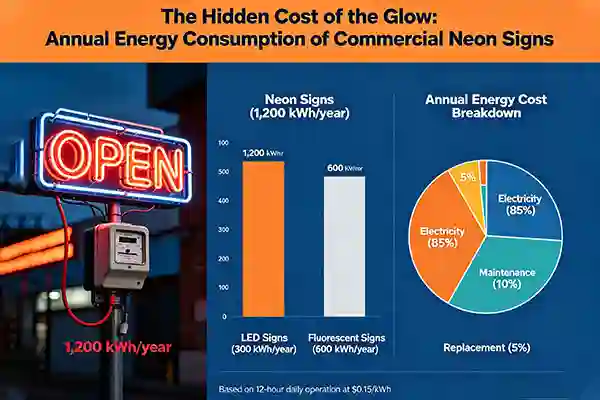
Understanding your neon sign energy cost is essential for budgeting. For business owners in 2026, every square foot of a storefront must justify its operating cost. As electricity rates fluctuate and “Green Business” certifications become a prerequisite for many commercial leases, the neon sign—a staple of retail branding—is under the microscope. The question is no longer just “Does it look good?” but “What does it cost to keep it on?” Traditional glass neon signs are energy-intensive relics with high commercial signage electricity expenses that can cost a business hundreds of dollars per year in electricity alone. In contrast, modern LED Neon Flex reduces annual energy consumption by approximately 80%, offering a sustainable alternative that typically pays for itself through utility savings within the first 14 months. For a commercial enterprise, switching to LED is the single most effective way to maintain a high-impact visual presence while drastically lowering the carbon footprint and operational overhead. 1. Breaking Down the Watts: Glass...

Commercial Neon Signs vs. LED: 2026 ROI Analysis

When evaluating LED neon ROI, businesses should look beyond aesthetics. When a business invests in signage, it isn’t just buying “decor”—it is investing in a 24/7 salesperson. In 2026, with rising energy costs and a hyper-competitive retail landscape, the debate between traditional glass neon and modern LED Neon Flex has shifted from aesthetics to a cold, hard Return on Investment (ROI) calculation. While traditional glass neon retains a niche “luxury” appeal for high-end branding, LED Neon Flex delivers a vastly superior ROI. For the average commercial enterprise, LED technology offers a 75–80% reduction in operating costs, a 300% longer lifespan, and near-zero maintenance liabilities, allowing the initial investment to be recouped in energy savings alone within the first 12 to 18 months of operation. 1. Upfront Capital Expenditure (CapEx) The first layer of ROI is the initial cost of acquisition. Traditional Glass Neon: Requires highly skilled manual labor. Each sign is hand-blown by a master craftsman. A custom 4-foot logo...

Traditional Neon vs LED: 2026 Business Showdown

When evaluating LED vs glass for business signage, several factors come into play. In 2026, as commercial energy regulations tighten and “Instagrammable” decor becomes a mandatory marketing expense, the choice of signage has never been more critical. For the vast majority of modern businesses, LED Neon is the superior investment. While traditional glass neon holds a prestigious “luxury” status and offers an irreplaceable 360-degree artistic glow for high-end boutique brands, LED Neon wins on energy efficiency (80% less power), durability (shattered glass is a liability), and ROI (lower upfront and maintenance costs). Unless your brand identity is strictly built on “heritage” or “vintage authenticity,” LED is the pragmatic business choice. 1.The Visual Impact: Branding and “The Glow” The first thing a customer notices is the quality of light. Traditional Glass: It offers a warm, high-end “buzz.” Because the gas glows inside a transparent tube, the light radiates in 360 degrees, creating a soft halo on the wall behind it. For...