
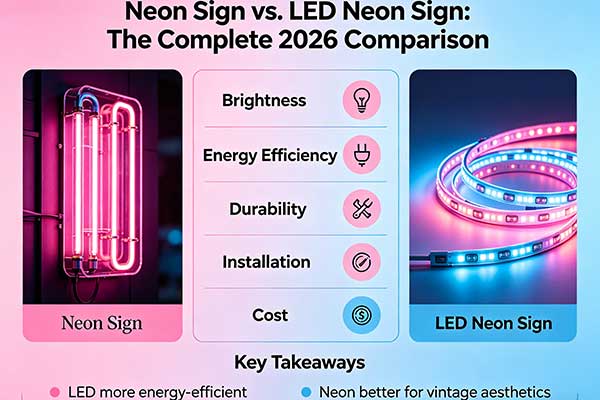
The glow of a neon sign is unmistakable — it is the heartbeat of late-night diners, the flair of modern weddings, and the focal point of trendy home offices. In 2026, however, the technology behind that glow has split into two distinct paths: the traditional artisan craft of gas-filled glass neon and the high-tech utility of LED Neon Flex.
Traditional glass neon remains a premium “art form” favoured by collectors and high-end luxury brands for its 360-degree warmth and vintage soul. LED Neon Flex, by contrast, has become the definitive choice for 98% of commercial and residential applications. With an 80% reduction in energy consumption, a shatterproof design, and a price point that is nearly 3x lower than glass, LED neon offers a superior return on investment (ROI) and safety profile without sacrificing the vibrant aesthetic of the classic “neon” look.
Whether you are weighing neon vs LED signs for a storefront, a home office or a wedding backdrop, the decision comes down to a handful of measurable factors: how the light is made, how it looks, what it costs to run, how long it lasts, how safe it is, and how quickly it can be customized. This guide works through all of them with the real numbers, so you can choose with evidence rather than marketing claims. If you simply want the answer first, start with the summary below.
Neon vs LED Signs: The Short Answer
For the vast majority of modern businesses, LED neon is the superior investment. Traditional glass neon holds a prestigious “luxury” status and offers an irreplaceable 360-degree artistic glow for high-end boutique brands. LED neon, however, wins on energy efficiency (80% less power), durability (shattered glass is a liability) and ROI (lower upfront and maintenance costs). Unless your brand identity is strictly built on heritage or vintage authenticity, LED is the pragmatic choice.
Here is the whole comparison on one screen:
| Factor | Traditional Glass Neon | LED Neon Flex |
| Light source | Ionized noble gas in bent glass tubes | High-density LEDs in a silicone diffuser |
| Energy use | High (high-voltage transformer) | Up to 80% lower (12V/24V) |
| Typical lifespan | 10,000 – 20,000 hours | 50,000 – 100,000 hours |
| Fragility | Fragile glass; breaks in transit and handling | Shatterproof silicone, cool to the touch |
| Upfront cost (name sign) | $600+ | $150 – $250 |
| Lead time | 4 – 8 weeks (skilled glass bender) | 3 – 7 days |
| Best for | Vintage bars, film sets, luxury heritage brands | Retail, hospitality, homes, events, outdoor signage |
LED vs Neon Signs: How Each Technology Works
Understanding the “why” behind the glow helps determine which fits your space.
- Traditional glass neon: this is a manual, labour-intensive process. A master glassblower heats lead-glass tubes over a ribbon fire and bends them by hand. The tubes are partially vacuumed, injected with noble gases (neon for red, argon for blue), and sealed with electrodes. High-voltage transformers then ionize the gas to create light.
- LED Neon Flex: this is solid-state lighting. It consists of high-density light-emitting diodes (LEDs) mounted on a flexible PCB, which is then encased in a thick, light-diffusing jacket made of high-quality silicone or PVC. It mimics the look of a glowing tube but functions like a modern computer component.
That single difference — ionized gas versus solid-state diodes — is the root cause of almost every other difference in this article. It is why one technology is fragile, hot and power-hungry, and the other is shatterproof, cool and efficient. If you want a deeper technical walkthrough of the two light sources, our guide to LED vs glass neon covers the materials and manufacturing in detail.
LED Sign vs Neon Sign: The Visual Impact and “The Glow”
The first thing a customer notices is the quality of light, and this is where a LED sign vs neon sign comparison gets subjective.
- Traditional glass: it offers a warm, high-end “buzz.” Because the gas glows inside a transparent tube, the light radiates in 360 degrees, creating a soft halo on the wall behind it. For a speakeasy bar or a heritage luxury brand, this authentic flicker is often worth the premium.
- LED Neon Flex: this uses high-density SMD LED chips inside a silicone diffuser. In 2026 the “pixelated” look is gone — it reads as a solid, vibrant beam. However, it is typically front-facing (120–180 degree beam angle), which makes it punchier and easier to read from a distance, and therefore better for directional signage and logos.
In practice, both technologies photograph beautifully, which is why “Instagrammable” decor has become a mandatory marketing expense for bars, cafés and salons. The practical difference is that LED neon produces a brighter, more even face for legibility at distance, while glass neon produces a softer, more atmospheric halo that flatters a dim interior. If signage ROI is your priority rather than pure atmosphere, it is worth reading our data on whether neon signs actually increase sales before you decide.
Neon vs LED Sign: Energy Efficiency and the “Hidden” Cost of the Glow
In an era of rising utility costs and green-energy mandates, power draw is the biggest differentiator in any neon vs LED sign decision.
| Metric | Traditional Glass Neon | LED Neon Flex |
| Input Voltage | 3,000V – 15,000V (High Voltage) | 12V – 24V (Low Voltage) |
| Power Consumption | ~15 – 20 Watts per foot | ~2 – 4 Watts per foot |
| Heat Emission | High (50°C – 80°C) | Minimal (25°C – 30°C) |
The data: running a medium-sized traditional neon sign for 12 hours a day can cost roughly $280/year. An equivalent LED sign costs approximately $45/year. Over a 5-year period, the LED sign saves you over $1,100 in electricity alone.
Those are not marginal savings — they are the kind of figure that quietly pays for the sign itself. That is why we describe energy as the “hidden” cost of the glow: the sticker price is only the beginning of what a sign costs you.
Operational Costs: Energy and Maintenance Over Time
For a business, every watt counts. Traditional neon requires high-voltage transformers (3,000 to 15,000 volts), and those transformers are also the component most likely to fail or need servicing.
| Metric | Traditional Glass Neon | LED Neon Flex |
| Power Consumption | 3.5 – 4 Watts per inch | 0.8 – 1.2 Watts per inch |
| Operating Voltage | High Voltage (Transformer) | 12V or 24V (Safe/Low) |
| Maintenance Frequency | High (gas refills, tube cracks) | Near Zero |
| Average Lifespan | 10,000 – 20,000 Hours | 50,000 – 100,000 Hours |
The data: running a 4-foot glass neon sign 12 hours a day can cost roughly $280–$350 per year in electricity (depending on regional rates). An equivalent LED sign costs approximately $50–$70 per year. Over five years, the LED sign pays for itself solely through energy savings.
Maintenance is the second half of the equation. Glass neon accumulates gas refills and hairline tube cracks, and each repair requires a specialist. LED neon is modular: if a segment fails, you replace that segment rather than the whole sign. If you want to model the numbers for your own premises, our breakdown of the annual energy consumption of commercial neon signs and our 2026 ROI analysis for business owners both work through the arithmetic in full.
Durability & Lifespan: Built to Last?
Where you plan to hang your sign determines which material you need.
- Fragility: glass neon is extremely delicate. A single hairline crack leaks the gas and kills the sign. It is notoriously difficult to ship and easy to break during installation.
- Shatterproof LED: LED Neon Flex is virtually indestructible. You can drop it, hit it with a ball, or install it in a high-traffic bar without fear.
- Rated lifespan: traditional neon runs 10,000 hours (with dimming beginning as the gas depletes), while LED Neon Flex is rated for 50,000 – 100,000 hours — roughly 11 years of continuous 24/7 use.
In a commercial setting this gap is decisive. A sign that must survive deliveries, cleaning crews, and customers brushing past it is a liability in glass and a non-issue in silicone.
Safety, Liability and Compliance: The Indoor and Retail Reality
For homes, bedrooms and retail environments, safety is the primary concern — and in a commercial environment it is also a legal and insurance concern.
- The “buzz” and heat: traditional neon hums and gets hot to the touch. If the glass breaks there is a risk of glass shards and, in some older blue or green tubes, trace amounts of mercury. Within reach of customers — especially in cafés or clothing stores — that heat also poses a burn risk.
- Child-safe LED: LED neon stays cool even after being on for weeks. Operating on 12V DC, there is zero risk of electric shock, and the body is made from flame-retardant silicone. It is shatterproof and remains cool to the touch even after 24 hours of operation.
- Codes and compliance: in 2026, most major shopping malls and fire codes now require LED over glass for interior public-facing signage.
For a business, glass neon can also affect insurance: some policies require special coverage for high-voltage glass signage. That is a recurring cost that rarely appears in a quote but does appear in your total cost of ownership.
Customization, Lead Times and Pricing
If you need a sign for an event next week, your choice is already made.
- Price comparison: a custom name sign in glass typically starts at $600+. The same sign in LED often starts at $150 – $250.
- Lead times: because glass requires a skilled artisan, expect a 4–8 week wait. A complex glass logo can take 4–6 weeks to produce, and if one letter breaks the whole sign usually has to go back to the shop. LED signs are often manufactured and shipped within 3–7 days, and can be cut and assembled in days.
- Dynamic effects: LED neon can do things glass cannot — RGB colour-changing, chasing patterns, and dimming via a smartphone app. Glass neon is typically “on or off.”
- Dimming: LED neon is also easier to dim. Most LED signs come with remote-controlled dimmers that adjust brightness from 10% to 100%. Traditional neon requires specialized, expensive dimmable transformers, which can sometimes cause the gas to flicker or “spiral” if not calibrated correctly.
This flexibility is what makes LED the “king” of social-media backdrops, where businesses refresh their Instagram wall every season, and of pop-up shops where the signage has to be produced faster than the promotion itself.
Industry-Specific Recommendations
Different business types benefit from different neon technologies:
- Restaurants and cafés with limited display windows benefit from the slim profile of LED neon panels, which mount flush against glass without obstructing the view.
- Retail stores requiring bright, consistent branding across multiple locations prefer LED for its colour uniformity and low maintenance.
- Bars and nightclubs aiming for an authentic vintage aesthetic may justify glass neon’s higher cost for its unparalleled atmospheric quality.
- Hotels and corporate spaces value LED’s programmability, allowing signs to change colour for events or seasons.
- Outdoor businesses will find LED’s weather resistance and waterproof ratings make it the only practical choice.
Hospitality is the clearest case study: for restaurants specifically, the trade-off between atmosphere and running cost is decided by the same factors covered here, and we break it down separately in neon sign vs LED sign for restaurants. When planning your commercial signage strategy, consider not just the initial cost but the total cost of ownership over 3–5 years, including energy consumption, maintenance, insurance and replacement frequency.
The Verdict: Purist vs. Pragmatist — Which Fits Your Business?
- The purist case: if you are restoring a vintage car, opening a 1950s-style speakeasy, or buying a piece of fine art, glass neon is irreplaceable. It has a 360-degree “soul” and a soft halo that LED has not quite perfected.
- The pragmatist case: for weddings, home decor, business logos and outdoor signage, LED neon is the undisputed winner. It is cheaper, safer, brighter and easier to maintain.
Put another way: choose traditional glass neon if you run a high-margin luxury brand, a vintage-themed bar, or a film production set where historical accuracy and artistic warmth are paramount. Choose LED Neon Flex if you are a startup, a restaurant, a retail chain or an e-commerce brand. It is the durable, cost-effective and safe solution that aligns with modern ESG (Environmental, Social and Governance) goals.
Frequently Asked Questions
Q1: Can traditional glass neon be repaired if it breaks?
Yes, but it is expensive. You must find a specialist glass bender (a dying trade) who can “patch” the glass and re-pump it with gas. Often, the cost of repair is 70% of the cost of a new sign. LED neon is modular and much cheaper to fix by replacing a segment.
Q2: Does LED neon look “dotty” or pixelated?
Not in 2026. High-density LED strips (with 120+ LEDs per metre) and advanced silicone diffusers have eliminated the “hot spots.” From a distance of more than 2 feet, most people cannot distinguish LED neon from traditional glass.
Q3: Is LED neon waterproof for outdoor use?
LED neon can be manufactured to IP67 standards, making it completely waterproof and snow-proof. While glass neon can be used outdoors, its high-voltage transformers are very sensitive to moisture and require heavy, expensive weatherproofing boxes.
Q4: Will my local council allow traditional glass neon signs on the street?
Many urban areas have updated their zoning laws in 2026 to favour LED signage due to light-pollution and energy-efficiency standards. Always check your local “Dark Sky” ordinances or building permits, as traditional neon’s high-voltage transformers often require specific electrical inspections.
Q5: Can LED neon achieve the same “dimming” effect as glass?
Actually, LED neon is easier to dim. Most LED signs come with remote-controlled dimmers that allow you to adjust brightness from 10% to 100%. Traditional neon requires specialized, expensive dimmable transformers which can sometimes cause the gas to flicker or “spiral” if not calibrated correctly.
Q6: How do I clean a commercial neon sign?
For LED, simply use a damp microfibre cloth (when turned off). For glass, cleaning is much more delicate; dust buildup on the glass tubes and high-voltage connections can lead to “arcing” (sparks), so it often requires professional cleaning or very careful dry-brushing to avoid snapping the tubes.
Recommended Reading
Explore our detailed commercial neon sign ROI analysis and learn about the annual energy costs of neon signs. See how LED compares to glass neon technology and discover how custom neon boosts brand visibility.
Check out our premium custom LED neon signs and see the difference for yourself. Looking for the perfect neon sign for your needs? Check out our light up your sales – store neon sign, our beauty neon sign – led salon light, or our yes we’re open neon sign – bright led storefront light to find exactly what you’re looking for.