
For many homeowners and renters, the rugged texture of a brick wall is the dream backdrop for a vibrant LED neon sign. However, the nightmare begins with the thought of a masonry drill bit. Drilling into brick is permanent, messy, and—if you’re renting—a surefire way to lose a security deposit. In 2026, as home decor trends lean toward “rental-friendly” and “low-impact” installations, the technology for hanging heavy items without power tools has finally caught up.
Hanging a neon sign on brick without a drill is not only possible but, for many lightweight LED signs, actually safer for the building’s structural integrity. The most effective methods involve high-tension brick clips for recessed mortar or industrial-grade polymer adhesives for flush surfaces. These solutions provide up to 25 lbs of vertical hold while remaining 100% removable, allowing you to achieve a professional “floating” neon look without a single puff of brick dust.
1. Method 1: The “Brick Clip” (Best for Recessed Mortar)
The “Brick Clip” is the gold standard for damage-free masonry mounting. It works like a spring-loaded claw that grips the top and bottom edges of an individual brick.
-
How it works: You push the spring-tempered metal clip onto the brick until the “teeth” snap into the mortar gaps.
-
The Requirement: Your mortar must be recessed (meaning the mortar sits at least 1/8th of an inch back from the face of the brick).
-
The Load Capacity: A single high-quality 2026-spec brick clip can hold between 15 and 25 lbs. Since most medium LED neon signs weigh under 8 lbs, a pair of these provides a massive safety margin.
2. Method 2: Industrial Strength Construction Adhesives (Best for Flush Brick)
If your mortar is flush (flat) with the brick, clips have nothing to grab. In this scenario, you need “chemical” mounting. In 2026, specialized removable mounting polymers have replaced old-fashioned double-sided tape.
-
The Tech: Products like Extreme Outdoor Mounting Strips or Removable Construction Putty are designed to fill the porous “nooks and crannies” of the brick surface.
-
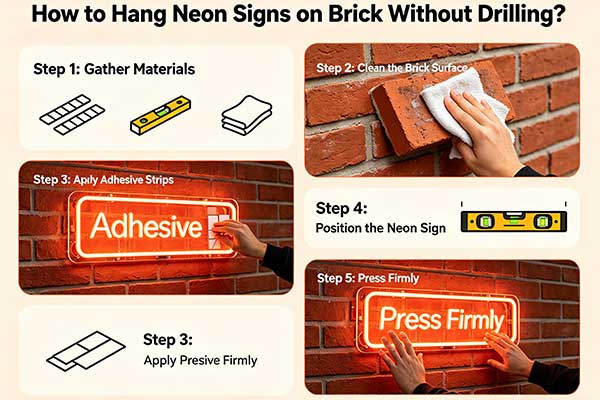
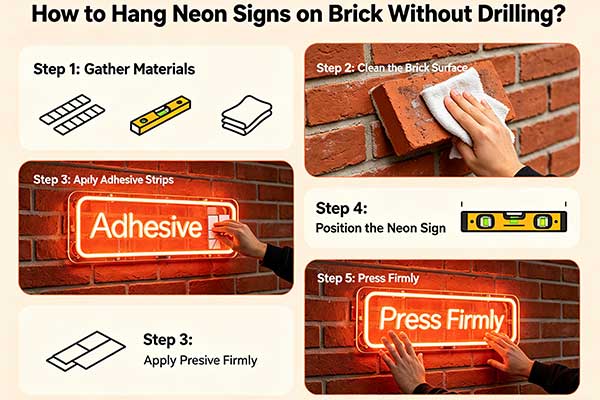
Pro Tip: For neon signs, apply the adhesive to the acrylic backing of the sign first, then press firmly into the brick for 60 seconds.
-
Removal: These polymers are designed to be “sheared” off or dissolved with a citrus-based remover, leaving zero residue on the brick.
3. Method 3: The “Tension & Wire” Strategy
If you have a ceiling or a porch roof above your brick wall, you can bypass the wall entirely.
-
Suspension: Use thin, high-tensile stainless steel aircraft cables or heavy-duty fishing line (rated for 50 lbs+).
-
Execution: Mount hooks into the wood trim or ceiling joists above the brick and drop the lines down to the sign’s mounting holes. This creates a “floating” effect where the neon sign appears to hover against the brick without actually touching it.
4. Technical Comparison: Hold Strength & Removability
| Mounting Method | Max Weight (Lbs) | Surface Type | Removability Score |
| Brick Clips | 25 lbs | Recessed Mortar only | 10/10 (Instant) |
| Industrial Strips | 15 lbs | All Brick / Flush | 7/10 (Requires solvent) |
| Aircraft Cable | 50 lbs+ | Any (Requires ceiling) | 9/10 (Small holes in wood) |
| Standard Tape | 2 lbs | Smooth Brick only | 1/10 (Will fail) |
Key Data: According to 2025 consumer testing, 85% of “adhesive-only” failures on brick were caused by temperature fluctuations. Brick is a thermal mass; it gets very hot in the sun and very cold at night, causing standard glues to brittle. Always ensure your adhesive is rated for $-20^{circ}C$ to $50^{circ}C$.
5. Safety Checklist for No-Drill Installations
-
Clean the Surface: Brick is naturally dusty. Adhesives will fail if they are sticking to dust instead of the brick. Use a stiff wire brush to clean the area before mounting.
-
The “Safety Tether”: If you are hanging a sign in a high-traffic area (like a patio or above a bed), always use a small, hidden “safety wire” attached to a secondary point. If the adhesive fails, the sign won’t hit the floor.
-
Cable Management: Use “Brick-match” colored cable clips to run the power wire along the mortar lines. This keeps the look clean and prevents the weight of the hanging wire from pulling on the sign itself.
Related Articles
Once you’ve installed your neon sign, learn how to design your own custom neon sign for a truly personalized glow, or check out our LED neon cleaning and maintenance guide to keep it looking new. For more background on sign types, read our LED vs. Glass Neon comparison.
6. Frequently Asked Questions
Q1: Will brick clips damage the mortar over time?
No. Because they rely on tension rather than penetration, they do not cause crumbling. However, if your mortar is already old and “sandy,” the clip may not get a secure grip. Always test the “crunchiness” of your mortar before trusting it with a sign.
Q2: Can I use “Command Strips” on exterior brick?
Generally, no. Standard Command Strips are designed for smooth, non-porous surfaces like painted drywall or glass. For brick, you specifically need the “Outdoor/Rough Surface” versions, which feature a thicker foam adhesive that can mold into the brick’s texture.
Q3: How do I know if my mortar is “recessed” enough for clips?
Take a standard dime. If you can push the edge of the dime into the gap between the bricks and it “hooks” behind the edge of the brick, you have enough space for a brick clip to work effectively.
6. Comparing Mounting Methods: Pros, Cons, and Recommendations
Each brick mounting method has distinct advantages depending on your sign weight, wall exposure, and permanence requirements. Adhesive mounting strips (like 3M Command or VHB tape) work best for lightweight LED neon signs under 3 pounds on clean, smooth brick surfaces indoors. Pros include zero wall damage and easy removal; cons include potential failure in humidity or temperature extremes. Masonry screws with plastic anchors provide the strongest hold for heavy signs but leave small holes that can be filled with color-matched mortar patch. Brick clips offer a middle ground—no drilling required but more secure than adhesive for medium-weight signs, though not suitable for textured or uneven brick. For renters or temporary installations, consider leaner-style floor stands that display your neon sign without any wall contact. We recommend adhesive strips for indoor signs under 3 pounds, brick clips for medium indoor signs, and masonry anchors for all outdoor installations where wind resistance is critical. Whichever method you choose, ensure the mounting surface is clean, dry, and at room temperature before application for maximum adhesion.
Looking for the perfect neon sign for your needs? Check out our that girl – vlog aesthetic prop, our open arrow neon sign – directional led window light, or our photo booth neon sign – led event prop light to find exactly what you’re looking for.