
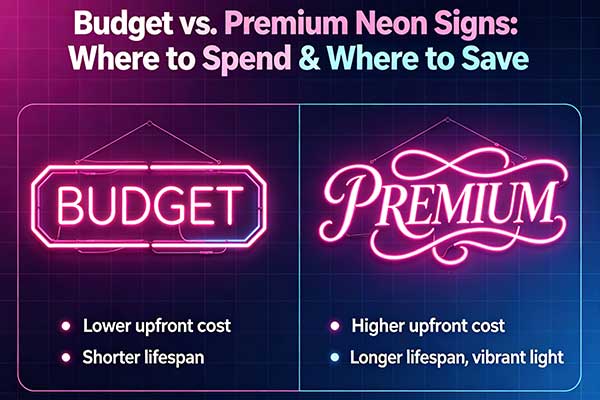
Two custom neon signs. Same word, same font, same size, same product photo. One costs $60, the other costs $300. If you have ever stood at that fork in the road, this page is for you. The gap is almost never the brand name — it is a handful of build decisions you cannot see in a listing photo, and once you know what they are you can tell a genuinely premium sign from an overpriced budget one before you pay a cent.
Related products: Book Nook – Custom LED Neon Sign, To Have and To Hold – Custom LED Neon Sign, Main Character – TikTok POV Sign, GRWM – Get Ready With Me Neon.
Related products: Good Things Are Coming Neon Sign, “Juliette” Christmas Neon Sign – Festive.
Below is the honest version: what changes between price tiers, why a sign that looks identical can cost five times more, where spending extra actually pays you back, and where you are simply buying marketing.
What Actually Separates a Budget Neon Sign From a Premium One?
There is no single “premium” part. An LED neon sign is only as strong as its weakest build decision, and manufacturers cut cost in a predictable order — starting with the things a buyer cannot see.
| Feature | Budget sign | Premium sign |
|---|---|---|
| LED density | 15–20 LEDs per metre | 30–40 LEDs per metre |
| Glow quality | Visible dots and hot spots | Continuous, even line |
| Backing board | 3–5mm thin acrylic or printed plastic | 6–10mm cast acrylic |
| Power supply | Generic no-name adapter | Correctly rated, UL-listed adapter |
| Warranty | None, or one that excludes LEDs and adapters | Written coverage of LED, adapter and dimmer faults |
| Design & control | Stock phrase, limited options | Custom design, dimmer + remote included |
| Shipping | Charged extra, slow | Often included |
Run your finger down that list and you can see why the two signs look the same on day one and unrecognisable a year later. The budget column is not “the same product for less”. It is a different product, built to a different cost target.
The five decisions that decide quality
Whether a sign lands in the budget column or the premium one comes down to five choices:
- LED density — how many LEDs sit behind each metre of light path. Dense runs read as one smooth line; sparse runs show individual dots.
- Brightness uniformity — whether the glow is even across the whole sign or patchy in places.
- Backing material — the board that keeps the sign flat. Thicker cast acrylic resists warping over time; thin plastic does not.
- Power supply — the driver that converts mains power to the 12V DC the sign needs, and the part most likely to fail first.
- Workmanship and testing — clean hand-soldered joints, and whether anyone actually bench-tested the unit before it shipped.
When a factory has to hit a lower price, it trims from this list in that order — starting with LED density, because that is the one you cannot see in a photo. For a deeper look at each build decision, read what actually makes a neon sign high quality.
Why Do Two Identical-Looking Signs Cost $60 and $300?
When two signs share one silhouette and one wide price gap, the difference is component cost, not markup. Here is where the money goes on a typical $200 custom sign:
| Line item | Share of price |
|---|---|
| LED flex tubing + silicone | ~35% |
| Acrylic backplate + CNC cutting | ~15% |
| Skilled hand-assembly labour | ~20% |
| Power adapter + remote + hardware | ~10% |
| Packaging + worldwide shipping | ~15% |
| Design + QC + warranty reserve | ~5% |
Now look at what has to disappear for a $60 sign to exist:
- The LED run drops from 30–40 LEDs per metre to 15–20 — the strip alone can cost half as much.
- Thick cast acrylic becomes a thin plastic sheet, and the sign stops staying flat.
- A rated, branded adapter becomes a generic no-name one — the single most common failure point on any sign.
- Bench testing is skipped and hand-soldered joints are rushed.
None of that is dishonest on its own. A $60 sign is a real product with a real use. But it is not a $300 sign sold cheaply, and it will not last like one. Our custom neon sign price guide walks through how size, complexity and colour count move the final quote.
Neon Sign Price Tiers: What $20, $150 and $1,000 Actually Buy You
| Price range | What to expect | Best for |
|---|---|---|
| $20–80 | Mass-produced, thin acrylic, cheap battery-powered LEDs. Often dims within months. No warranty. | One-time party decoration |
| $80–200 | Mid-range materials, decent LEDs that may have uneven brightness, limited custom options, variable quality. | Temporary signage, dorm rooms |
| $150–400 | Premium LEDs, 8mm acrylic backplate, custom design, dimmer + remote, written warranty, worldwide shipping included. | Home decor, weddings, business |
| $400–1,000+ | Very large signs (100cm+), complex multi-colour designs, premium metal frames. Same core technology as the mid-range. | Large commercial installations |
| $1,000–3,000+ | “Designer” brands using the same LED technology as the $150–400 tier. You are paying for the name. | Status buyers — not recommended |
Two things stand out. First, the jump from $200 to $400 buys real, measurable upgrades — better LEDs, a thicker backplate, a safe adapter, a warranty. Second, the jump from $400 to $1,000+ buys size and complexity, not better light. Above roughly $400 you are paying for scale and finish, and above $1,000 you are often paying for a brand name sitting on the same core technology as a mid-range sign.
Is a Cheap Neon Sign Ever Worth Buying?
Yes — in the right scenario. A budget sign is a sensible purchase when:
- You need a one-time prop for a single event, shoot or party.
- The sign is decorative filler, not the centrepiece of the room.
- You are testing a design before commissioning a permanent version.
- You accept that it will dim within months and you are fine replacing it.
It is the wrong purchase when the sign has to earn its keep — a storefront, a business wall, a wedding backdrop, or anything you plan to keep for years. The classic mistake is buying a $35 sign for a business and replacing it three times in two years, at which point a single well-built sign would have cost less.
If budget is the real constraint, the smarter move is not to buy the cheapest sign — it is to buy the smallest, simplest version of a good sign. A single-colour, standard-size sign from a real manufacturer keeps the quality and drops the extras. Our guide to cheap neon signs that are still worth buying covers exactly where those savings live.
How to Tell If a “Premium” Sign Is Really a Budget Sign
The hardest case is not a cheap sign. It is an expensive sign hiding cheap parts. Ask these five questions before you pay:
- “Can you send a close-up photo of a lit sign?” Budget LEDs show visible individual dots; premium LEDs read as a smooth, continuous line.
- “How thick is the acrylic backplate?” You are listening for 6–10mm. “Thick” without a number is a dodge.
- “Is the power adapter certified?” A correctly rated, listed adapter matched to your country’s voltage and plug type is non-negotiable. Cheap adapters overheat, flicker and fail.
- “What does the warranty actually cover?” A real one names LED failure, the adapter and the dimmer. A vague “lifetime” promise that excludes LEDs, power supplies and “normal wear and tear” covers nothing that can actually go wrong. Our neon sign warranty guide breaks down what a fair policy looks like.
- “Do you manufacture, or resell?” A factory can answer material questions on the spot and show you its workshop. A middleman says “let me check with our team”. Here is how to tell factory-direct from a middleman.
If a seller cannot answer the first three, the price tag is telling you nothing about the product underneath it.
Features Worth Paying For — and the Ones to Skip
Spend here
- LED quality. This is the number one factor in how the sign looks and how long it lasts. Quality LEDs hold roughly 90% of their brightness for 30,000+ hours — about a decade of nightly use — while budget LEDs can dim noticeably inside the first year. Y SIGNS uses premium LEDs with even, colour-accurate output.
- Acrylic backplate thickness. Premium signs use 8–10mm acrylic; budget signs use 3–5mm, which warps over time, especially in warm rooms or near windows. A thicker backplate also gives you better mounting stability.
- Power adapter. A safe, properly rated adapter protects the sign and your home. Every Y SIGNS sign ships with a certified adapter matched to your country’s voltage and plug.
- A real warranty. It means the manufacturer stands behind the product. If an LED segment, the dimmer or the power supply fails, it is covered.
Skip these
- “Lifetime warranty”. On a cheap sign this is marketing, not protection. Read the fine print — it usually excludes LEDs, power supplies and normal wear and tear, which is everything that actually fails. A straightforward warranty from a reputable maker is worth far more than an infinite promise from an anonymous dropshipper.
- RGB / colour-changing LEDs. Most owners settle on one or two colours and never touch the rest. RGB runs also tend to be less bright and less colour-accurate than single-colour LEDs, and add roughly $30–60. Warm white (3000K) is the most versatile and photographs best; if you want colour, pick one of the single-colour options and keep it.
- App / smart-home control. The apps are often buggy and the connection unreliable. A simple remote and dimmer — included with every Y SIGNS sign — handles on/off, brightness and mode settings. Want smart control anyway? A $10 smart plug gets you there with less friction.
- Rush production fees. Standard production runs 7–14 days, fast enough for almost everyone. Rush orders can add 20–50% to the price. Unless you genuinely need the sign in under a week, plan ahead and keep the money.
The Best Value Range — and How to Avoid the Brand Tax
Based on materials, build quality and long-term durability, the $150–400 range is where a custom neon sign stops being a gamble and starts being an investment. You get premium LEDs, a solid acrylic backplate, safe certified electronics, a written warranty and worldwide shipping included.
That is exactly where Y SIGNS positions its products. We do not compete with $30 Amazon signs — that is a different product entirely. And we do not charge $2,000 for a brand name sitting on the same core LED technology. We build premium-quality, factory-direct signs at honest prices and include worldwide shipping, because we are the factory rather than a reseller marking up someone else’s work. That single fact is why the sweet spot and the brand tax never meet on the same invoice.
Common Questions About Budget and Premium Neon Signs
Is a $60 neon sign the same as a $300 one?
No. They can share a silhouette and look identical in a photo, but the cheaper sign uses a sparser LED run, a thinner backing and a generic adapter, and usually carries no meaningful warranty. The difference shows up within months, not years.
Do I need to spend more than $400?
Only if you need size or complexity. A 100cm+ multi-colour sign costs more because it uses more tubing, more material and more labour — not because the light is better. For a standard-size sign, the $150–400 range is where the quality ceiling sits.
Why are designer neon signs so expensive?
Above roughly $1,000 you are usually paying for the brand, not the build. Those signs use the same core LED technology as the $150–400 tier. If the price is three times higher and the spec sheet is not, you are buying a name.
What is the single best place to save money?
Strip the extras: single colour instead of RGB, standard size instead of oversized, no rush fee, no app control. Keep the LED quality, the acrylic thickness and the certified adapter. That combination gets you a premium sign at a mid-range price.
How long should a good neon sign last?
Quality LED neon is rated for 50,000–100,000 hours — over 30 years at eight hours a night — before it dims to around 70% of its original brightness. A budget sign with a generic adapter often fails far sooner, and the adapter is usually the first thing to go.
Ready to buy at the value end instead of the gamble end? Build your sign in our custom neon sign designer and see the price before you commit.