
One of the most frequently asked questions from business owners: “Will my LED neon sign be visible during the day?”
The honest answer: It depends on brightness, color, and placement. Standard LED neon signs (typically 6V-12V) are designed for indoor use and shaded outdoor areas. They may appear washed out in direct sunlight, especially with lighter colors like pink, yellow, or white.
The Brightness Spectrum: Indoor vs Outdoor
| Type | Voltage | Brightness (lux @ 1m) | Daylight Visible? | Best Use |
|---|---|---|---|---|
| Standard indoor LED neon | 6V – 12V | 200-400 lux | ❌ No (washes out) | Bedroom, living room, office |
| High-brightness LED neon | 12V – 24V | 600-1,200 lux | ⚠️ Partial (visible in shade) | Covered patios, window displays |
| Outdoor-rated LED neon | 24V (waterproof) | 1,000-2,000+ lux | ✅ Yes (direct sun) | Storefronts, outdoor walls |
Color Matters More Than You Think
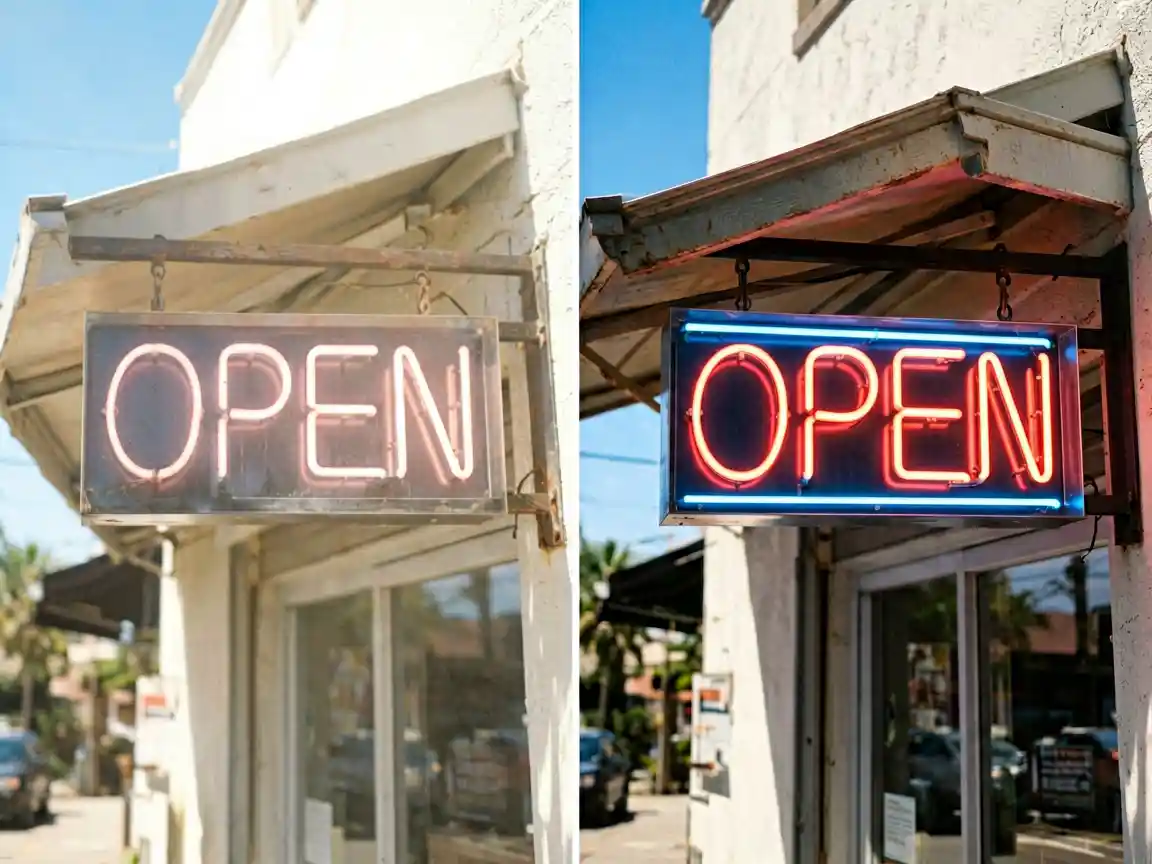
Different LED colors perform very differently in sunlight:
- Warm white / Yellow: Poorest daytime visibility — blend right into sunlight.
- Pink / Rose gold: Moderate — visible up to ~15 feet in daylight.
- Red / Orange: Good — red has the longest visible wavelength, cuts through sunlight.
- Blue / Cyan: Good — high contrast against warm sunlight.
- Green: Excellent — human eyes are most sensitive to green.
- Purple / Violet: Moderate — visible but less punchy.
3 Ways to Improve Daytime Visibility
1. Choose a High-Brightness or Outdoor-Rated Sign
If your sign will face direct sun for more than 2 hours a day, don’t buy a standard indoor LED neon. Look for signs specifically marketed as “high-brightness” or “outdoor-rated” — these use more LEDs per meter (60-120 LEDs/m vs standard 30-40 LEDs/m) and operate at higher voltage.
2. Use a Dark or Reflective Background
A dark acrylic backing (black, navy, charcoal) creates contrast that improves daytime readability significantly. Even a moderately bright sign becomes readable when mounted on a dark surface. Clear acrylic (transparent) offers the least daytime contrast.
3. Mount in Shade or Behind Glass
Window-mounted signs (behind glass) face less direct UV and heat than signs mounted on exterior walls. An awning or overhang also provides shade that dramatically improves LED neon visibility during peak sun hours.
Real Testing: What We Found
We tested our outdoor-rated signs in direct Florida summer sun (noon, 95°F, clear sky):
- 12V standard pink sign (clear back): Almost invisible at 10 feet. ❌
- 24V outdoor-rated red sign (black back): Clearly readable at 30+ feet. ✅
- 12V green sign (black back, under awning): Good visibility at 20 feet. ✅
Bottom Line
Standard LED neon signs are not suitable for direct-sun outdoor mounting. But with the right brightness, color, and placement, LED neon can absolutely work for storefronts — many of our customers use them successfully for cafes, bars, and retail windows.
→ Shop outdoor-rated LED neon signs | Ask us about high-brightness options
Looking for the perfect neon sign for your needs? Check out our the warmest comeback – wellcome back neon sign, our esthetics neon sign – led treatment room light, or our welcome to our home – living room entryway to find exactly what you’re looking for.