
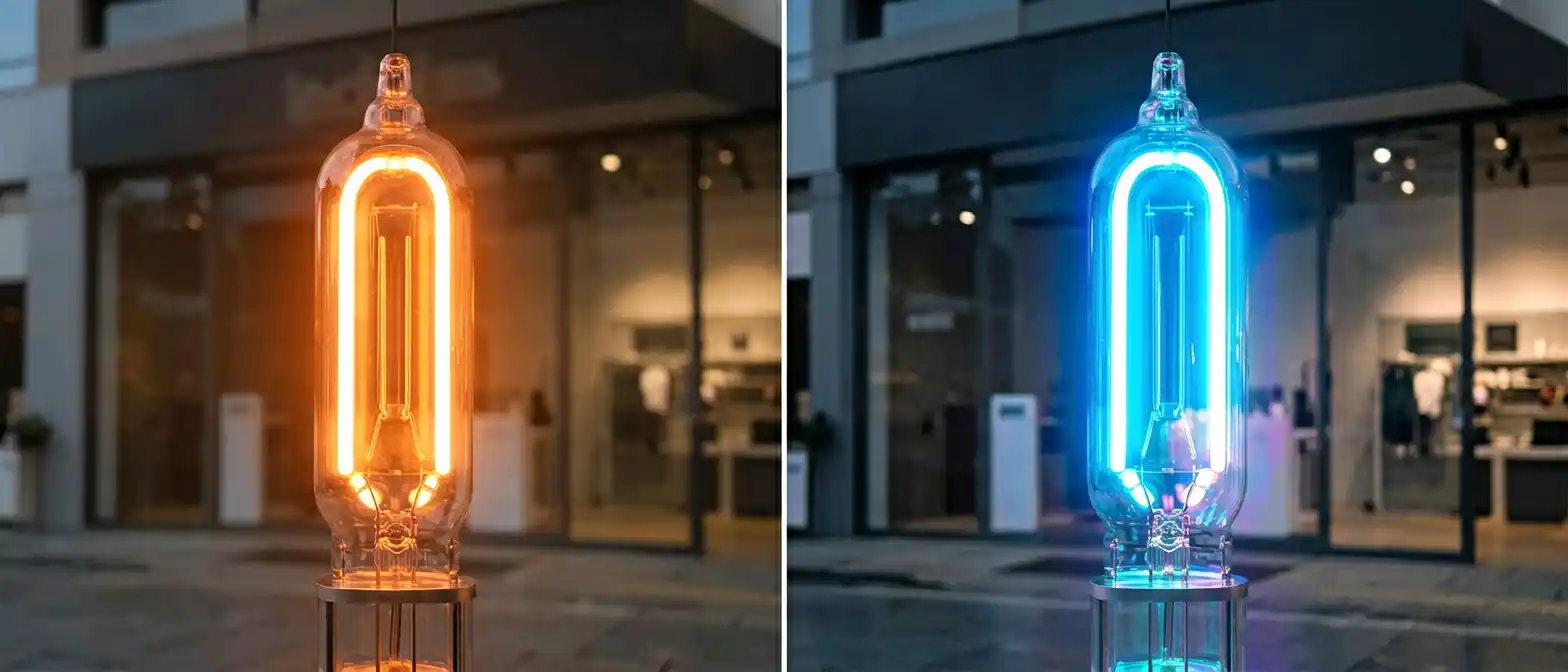
Neon vs Glass: Which One Is Right for Your Business?
Walk down any main street, and you’ll see both styles — classic glass tube neon glowing with nostalgic warmth, and modern LED flex neon in crisp vibrant colors. Both say “signage,” but they serve very different purposes.
If you’re investing in signage for your business, the choice between traditional glass neon and modern LED flex directly affects your budget, maintenance schedule, and visual branding. Here’s the honest breakdown.
Quick Comparison Table
| Factor | Traditional Glass Neon | Modern LED Flex Neon |
|---|---|---|
| Aesthetic | Warm, vintage, authentic glow | Clean, bright, customizable |
| Durability | Fragile — glass breaks on impact | Flexible rubber — impact-resistant |
| Energy Usage | High voltage (5-15 kV) | Low voltage (12-24V DC) |
| Lifespan | 3-5 years average | 50,000+ hours (10+ years) |
| Color Options | Limited to gas colors | Full RGB spectrum |
| Weather Resistance | Sealed enclosure needed | IP65 outdoor rated |
| Weight | Heavy — requires robust mounting | Lightweight — easy wall mount |
| Repair | Specialist needed, expensive | Replace component, inexpensive |
| Temperature Range | Sensitive to cold/heat | -40°C to +60°C |
| Operating Cost | Higher (transformer power) | Minimal (LED efficiency) |
| Design Flexibility | Limited by glass bending | Nearly unlimited |
When Traditional Glass Neon Is the Right Choice
For all its drawbacks, glass neon has a look that LED can’t fully replicate. These are the scenarios where glass still makes sense:
Cocktail bars, tattoo shops, vintage diners, and boutique bakeries often deliberately choose glass neon for its authentic glow. The subtle flicker and warm orange/red tones of real gas discharge create an atmosphere that customers associate with craftsmanship and tradition.
High-end art pieces and museum installations sometimes require the organic look of hand-blown glass tubes. The depth and texture of glass neon — particularly in multi-layered pieces — is difficult to achieve with LED extrusions.
Some municipalities mandate original-period materials for signs in historic districts. Check your local signage regulations — if glass is required, you have no practical alternative.
When LED Flex Is the Clear Winner
For most modern commercial applications, LED flex neon outperforms glass in every practical dimension:
| Situation | Why LED Wins |
|---|---|
| High-traffic entrances | No broken glass hazard if bumped |
| Humid bathrooms / outdoor patios | IP65 waterproof rating handles moisture |
| Frequent rebranding | Swap panels overnight — low cost |
| Multiple color schemes | RGB LED changes color with a remote |
| Budget-conscious startups | Lower upfront cost, no specialist installation |
| Shipping internationally | Flexible neon is nearly unbreakable in transit |
Total Cost of Ownership Comparison
Sticker price tells only part of the story. Over 5 years, LED flex neon costs significantly less:
- Year 1 — Installation: Glass requires licensed electrician (transformer + high voltage wiring). LED plugs into any standard outlet — DIY in minutes.
- Years 2-5 — Maintenance: Glass: annual bulb checks, transformer replacement risk ($100-300). LED: occasional dusting — no consumable parts.
- Year 5+ — Replacement: Glass likely dimming or failed. LED still at 80%+ brightness — may outlast your lease.
3 Questions to Decide
Not sure which path fits your business? Answer these three questions honestly:
- Does your sign need to withstand physical contact?
Yes → Choose LED flex. Glass cannot survive daily human interaction without risk. - Will your branding or color scheme change?
Yes → Choose programmable LED. Glass is static from the moment it’s made. - Is budget your primary constraint?
Yes → Choose LED flex. Equivalent sign costs 30-50% less and lasts 2-3x longer.
Our Recommendation
For the vast majority of businesses — retail stores, restaurants, offices, salons, and service providers — modern LED flex neon delivers the best combination of performance, durability, flexibility, and value. Traditional glass neon remains a niche choice for specific vintage aesthetics and heritage applications.
Explore our commercial LED neon collection with ready-to-order sizes and colors, or start a custom design for a fully personalized business sign.
Not sure about your space measurements first? Read our complete measurement guide to ensure your sign fits perfectly.
FAQ: Neon vs Glass
- Q: Is LED neon as bright as glass neon? Typically brighter — LEDs produce more lumens per watt and offer consistent color temperature across the entire sign.
- Q: Can LED neon look like real glass? Modern LED flex with frosted tubing closely mimics glass neon’s diffused glow — most customers cannot tell the difference.
- Q: Is glass neon dangerous? Glass neon operates at high voltage (5-15 kV). When properly installed and enclosed, it’s safe, but repair and maintenance carry risks that LED does not.
- Q: Which lasts longer? LED flex wins by a wide margin — 50,000+ hours vs 8,000-15,000 hours for glass neon.
- Q: Can I combine both styles? Yes — some designers use glass for hero elements and LED for background/ambient lighting for layered depth.