
When shopping for an LED neon sign, one of the most important decisions you will face is power: battery-powered vs plug-in neon signs. Both options deliver the same beautiful glow, but they serve very different use cases. Choosing the wrong type can mean dealing with dead batteries mid-party or a power cord that ruins your clean installation.
In 2026, the LED neon market offers mature versions of both technologies. Battery-powered neon signs have improved dramatically, offering 8-12 hours of runtime on a single charge, while plug-in signs remain the gold standard for permanent installations. This guide compares every factor so you can make the right choice for your specific needs.
1. Battery-Powered Neon Signs: Pros and Cons
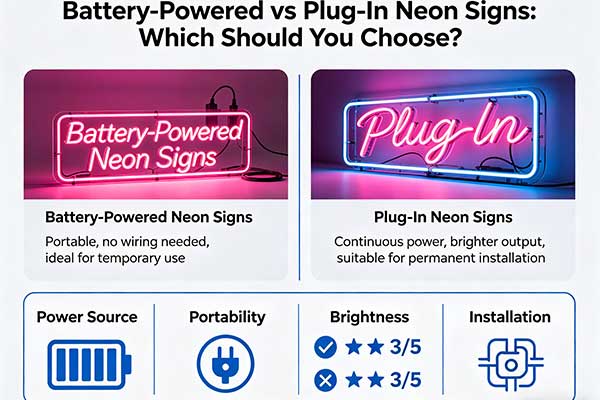
Advantages: True portability. Battery neon signs can go anywhere—outdoor patios without outlets, photo booths at rented venues, food trucks without generator hookups, and as decor that moves with you. They are also easier to install because there is no cord to hide. Most battery-powered signs use USB-C rechargeable batteries that reach full charge in 3-4 hours.
Disadvantages: Limited runtime. Most battery-powered neon signs last 6-12 hours per charge, depending on brightness settings and sign size. The battery housing adds slight weight and thickness to the sign. You must remember to charge the sign regularly for permanent installations. Battery-powered signs are typically 10-20% less bright than their plug-in counterparts to conserve power.
2. Plug-In Neon Signs: Pros and Cons
Advantages: Unlimited runtime and maximum brightness. Plug-in neon signs can run 24/7 without any power management. They are typically brighter than battery-powered equivalents, making them ideal for storefronts and commercial applications. Plug-in signs are lighter because they lack a battery pack, and they have a smaller physical profile for a cleaner look.
Disadvantages: Cord management required. The power cord must be routed and hidden, which can be challenging on feature walls or in rooms without nearby outlets. Plug-in signs are less portable and require access to a standard wall outlet within the cord’s reach (typically 6 feet).
3. Brightness Comparison
Plug-in neon signs deliver 400-500 lumens of brightness, suitable for commercial environments and daylight visibility. Battery-powered neon signs typically deliver 250-350 lumens—still bright enough for indoor use and evening outdoor settings, but noticeably dimmer in direct sunlight or brightly lit commercial spaces. For photo booth neon signs used at indoor events, both power types provide sufficient illumination.
4. Best Use Cases for Each Type
Battery-Powered Is Best For:
- Food trucks and mobile vendors (see food truck neon signs)
- Outdoor events and weddings without reliable power
- Renters who want zero cord management
- Seasonal decor that moves between storage and display
- College dorm rooms with limited outlet access
Plug-In Is Best For:
- Permanent home and office installations
- Commercial storefronts and business branding
- 24/7 retail and hospitality environments
- Large format signs over 36 inches wide
- Any application where brightness is the top priority
5. Cost Comparison
Battery-powered neon signs cost $10-30 more than equivalent plug-in models due to the integrated battery and charging circuitry. However, they eliminate the need for professional electrical work or extension cords. Over the sign’s lifetime (50,000+ LED hours), the plug-in model is more economical because there are no batteries to replace. For a detailed breakdown of long-term costs, see our custom neon sign pricing guide.
6. Environmental and Energy Considerations
Both battery-powered and plug-in neon signs use LED technology, which consumes 90% less energy than traditional glass neon. A plug-in sign uses approximately 12-24 watts. A battery-powered sign charges from the grid and uses similar total energy, though charging efficiency varies. Battery recycling is recommended for integrated battery packs at end of life. The LED neon sign lifespan of 50,000+ hours applies equally to both power types.
Related Articles
- How Much Do Custom Neon Signs Cost? 2026 Pricing Guide
- Can Neon Signs Be Used Outdoors? Weatherproofing Guide
- Food Truck Neon Signs: Stand Out on Every Corner
- How to Install Neon Signs Without Damaging Walls
7. Frequently Asked Questions (FAQ)
How long do battery-powered neon signs last on a charge?
Most models provide 6-12 hours of continuous use at medium brightness. High-brightness mode reduces runtime to 4-6 hours. Dimming to 50% brightness can extend runtime to 14+ hours.
Can I use my plug-in neon sign with a portable battery pack?
Yes. Plug-in signs use standard 12V DC power. A portable power station or USB-to-DC adapter can make a plug-in sign portable, though this is less convenient than a dedicated battery model.
Are battery-powered signs less bright?
Slightly. Battery-powered signs are typically 70-80% as bright as plug-in equivalents to conserve power. For most indoor applications, this difference is barely noticeable.
Can I leave a battery-powered sign plugged in?
Yes. Most battery-powered neon signs have pass-through charging, allowing them to run while charging. This effectively gives you unlimited runtime with backup battery operation when unplugged.
8. Conclusion
The choice between battery-powered and plug-in neon signs comes down to your specific setup. For permanent installations where maximum brightness and zero maintenance matter, choose plug-in. For portability, events, and flexible decor, battery-powered is the clear winner. Many customers ultimately buy both types—a permanent plug-in for home and a portable battery-powered sign for events and outdoor use.
7. Smart Features and Modern Innovations
Recent innovations in neon sign technology have blurred the line between battery-powered and plug-in options. Modern battery-powered LED neon signs now feature USB-C charging, allowing them to be powered by standard phone chargers, power banks, or laptops when wall outlets are unavailable. Some models offer wireless charging capabilities through integrated Qi charging pads, eliminating physical charging ports and improving water resistance. Smart battery management systems automatically dim the sign when battery levels drop, extending usable time by up to 40% compared to older models. On the plug-in side, innovations include voice control integration, programmable daily schedules, and WiFi-connected signs that can be controlled remotely from anywhere. Some premium models feature ambient light sensors that automatically adjust brightness based on room lighting conditions, conserving energy without sacrificing visual impact. As battery technology continues to improve (lithium polymer cells are now standard), the performance gap between battery and plug-in options narrows steadily, making battery-powered choices increasingly viable for permanent installations where convenience and flexibility are priorities.
Looking for the perfect neon sign for your needs? Check out our better together – living room shared space for couples, our explore. dream. discover. – kids’ study & creativity corner, or our charlie dog neon sign – illuminate your love to find exactly what you’re looking for.