
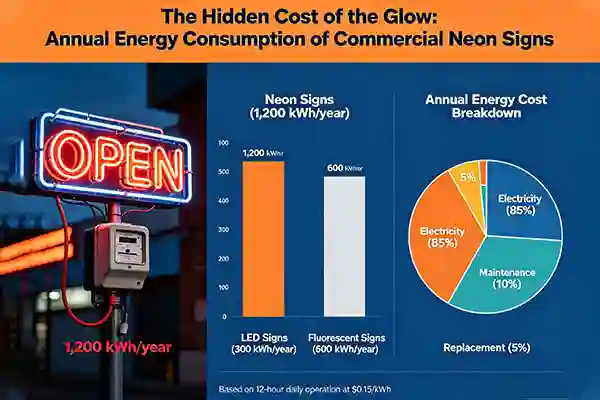
Understanding your neon sign energy cost is essential for budgeting. For business owners in 2026, every square foot of a storefront must justify its operating cost. As electricity rates fluctuate and “Green Business” certifications become a prerequisite for many commercial leases, the neon sign—a staple of retail branding—is under the microscope. The question is no longer just “Does it look good?” but “What does it cost to keep it on?”
Traditional glass neon signs are energy-intensive relics with high commercial signage electricity expenses that can cost a business hundreds of dollars per year in electricity alone. In contrast, modern LED Neon Flex reduces annual energy consumption by approximately 80%, offering a sustainable alternative that typically pays for itself through utility savings within the first 14 months. For a commercial enterprise, switching to LED is the single most effective way to maintain a high-impact visual presence while drastically lowering the carbon footprint and operational overhead.
1. Breaking Down the Watts: Glass vs. LED
To understand the annual cost, we must first look at the hourly draw.
-
Traditional Glass Neon: These signs rely on high-voltage transformers (3,000V to 15,000V) to ionize the gas inside the tubes. This process is inherently inefficient, as a significant portion of the energy is lost as heat. On average, traditional neon consumes 3.5 to 4 watts per linear inch.
-
LED Neon Flex: This technology uses low-voltage (12V or 24V) Light Emitting Diodes. LEDs are designed to convert almost all energy into visible light with minimal heat byproduct. Modern commercial LED strips consume only 0.8 to 1.2 watts per linear inch.
2. Annual Energy Consumption Comparison (The Data)
Let’s look at a standard 4-foot (48-inch) custom “OPEN” sign or logo running for 12 hours per day, 365 days a year.
| Metric | Traditional Glass Neon | LED Neon Flex |
| Hourly Consumption | ~180 Watts | ~45 Watts |
| Daily Consumption | 2.16 kWh | 0.54 kWh |
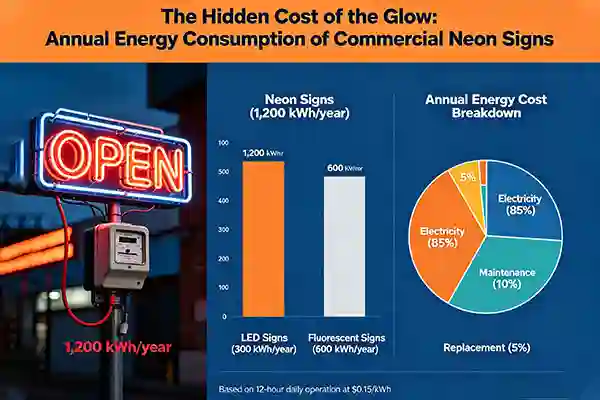
| Annual Consumption | 788.4 kWh | 197.1 kWh |
| Estimated Annual Cost ($0.20/kWh) | $157.68 | $39.42 |
The Bottom Line: For a single medium-sized sign, the energy savings exceed $118 per year. For a franchise with 50 locations, switching to LED saves nearly $6,000 annually in pure utility costs.
3. Beyond the Bill: The Cost of “Waste Heat”
In a commercial setting, energy consumption isn’t just about the sign itself—it’s about the environment.
-
The HVAC Burden: Traditional glass neon signs can reach surface temperatures of over 65°C (150°F). In a small retail shop or a restaurant booth, this heat is pumped directly into the room. Your air conditioning system must work harder to counteract the heat generated by the signage.
-
The LED Advantage: LED neon remains cool to the touch (typically around 30°C). It adds zero significant load to your cooling system, providing secondary “hidden” energy savings that are rarely factored into the initial ROI.
4. Longevity and “Efficiency Decay”
ROI isn’t just about the first year; it’s about the lifecycle.
-
Glass Neon: Over time, the electrodes in glass tubes wear down, and the gas may deplete or become contaminated, leading to flickering and increased resistance. This can cause the transformer to draw even more power as it struggles to maintain the arc.
-
LED Neon: Rated for 50,000 to 100,000 hours, LEDs maintain consistent energy efficiency until the very end of their life cycle. In 2026, most commercial-grade LEDs are equipped with “smart drivers” that prevent power surges and further optimize consumption.
5. Environmental Impact & ESG Goals
In 2026, “Energy ROI” is also measured in carbon.
-
Carbon Footprint: Based on average grid emissions, a single traditional neon sign produces roughly 300kg of CO2 per year. An LED equivalent produces only 75kg.
-
Sustainability Incentives: Many cities now offer “Green Grants” or tax rebates for businesses that replace high-intensity discharge lighting (like glass neon) with certified LED alternatives. This can often cover up to 50% of the replacement cost.
Related Reading
Explore our commercial neon sign ROI analysis for a deeper financial breakdown. Learn how LED compares to glass for business signage and discover the safety benefits of silicone LED neon. For a complete technology comparison, check our LED vs glass neon guide.6. Frequently Asked Questions
Q1: Does turning the sign on and off frequently use more energy?
No. Unlike older fluorescent lights that require a “starter” surge, both LED and modern electronic neon transformers draw a consistent amount of power from the moment they are switched on. However, using a timer or light sensor is highly recommended to ensure the sign isn’t running during daylight hours when its impact is lower.
Q2: Will a dimmer switch save me money on my energy bill?
Yes. For LED neon signs, reducing the brightness via a dimmer directly reduces the wattage consumed. If you run your sign at 50% brightness during the evening, you are roughly halving its electricity consumption for those hours.
Q3: Is it cheaper to leave the sign on 24/7 or turn it off at night?
Unless you are a 24-hour business, always turn the sign off. While the draw of a single LED sign is low, leaving it on 24/7 doubles your annual energy consumption compared to a 12-hour cycle and unnecessarily shortens the lifespan of the LEDs.
7. Smart Energy Management for Commercial Neon
Beyond choosing LED over glass neon, several additional strategies can further reduce your commercial signage energy costs. Installing photocell sensors that automatically dim or turn off signs during daylight hours can reduce energy consumption by 40-60%. Timers that turn off signs during closed hours (when less marketing benefit is gained) also contribute to savings while extending sign lifespan. For businesses operating 24 hours, consider dimmable neon that reduces brightness by 50% during late-night hours when foot traffic is minimal but brand presence is still valuable. Some modern LED neon systems offer smart controls via mobile apps, allowing business owners to schedule brightness levels, set automatic on/off times, and monitor energy usage remotely. Combining these strategies with an Energy Star-rated LED neon sign can reduce your annual signage electricity costs by 80-90% compared to traditional glass neon alternatives.Looking for the perfect neon sign for your needs? Check out our business neon sign collection, our business neon sign collection, or our business neon sign collection to find exactly what you’re looking for.